
This post contains affiliate links. As an Amazon Associate, I earn from qualifying purchases.
📌 TL;DR
- No dog body language signal means anything on its own — dogs communicate in clusters of three or more
- Stress signals follow a predictable ladder, starting with tiny cues like a lip lick and ending in a bite
- The quiet signals at the bottom of that ladder are the ones almost every owner walks straight past
- Every signal below comes with what to actually do the moment you spot it
Your dog has been talking to you all day. A lip lick when your nephew leaned in. A yawn that had nothing to do with being tired. A tail that kept moving while the rest of the body went still.
Dog body language signals work in clusters, never alone — and once you can read three at a time instead of one, you stop guessing what your dog feels and start actually knowing.
Here are the fifteen that matter most, and what to do about each one.
Why Can’t You Read Just One Dog Body Language Signal?
Because a single signal is almost meaningless. A wagging tail on a stiff, frozen body is a completely different message than the same wag on a loose, wiggly one.
Every trainer worth listening to says the same thing: read the whole dog. Ears, eyes, mouth, tail, weight distribution, and what’s happening around them. Three signals pointing the same direction is a message. One signal on its own is a guess.
In my experience, this is where nearly every owner goes wrong. They learn that a tucked tail means fear, then they spend years watching only the tail and missing the seven other things happening at the same time.
The Three-Signal Rule
Before you decide what your dog is feeling, find three signals that agree. Loose body plus soft eyes plus a low relaxed wag means a comfortable dog. Stiff body plus hard stare plus a high fast wag means something very different.
Two out of three isn’t enough. Look for the third.
The 15 Dog Body Language Signals, Grouped By What They Mean
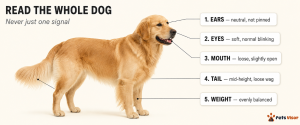
These fall into three buckets: comfortable, uncertain, and warning. The uncertain ones matter most, because that’s where you can still change the outcome.
Comfortable Signals
1. Loose, wiggly body. No tension anywhere. The whole back half might sway with the tail. This is a dog with nothing on their mind.
What to do: Nothing. Enjoy it. This is your baseline — the more you notice what relaxed looks like on your specific dog, the faster you’ll spot when it disappears.
2. Soft eyes with normal blinking. Almond-shaped, no whites showing, blinking at a normal rate. Sometimes half-closed.
What to do: This is a good moment for affection if your dog enjoys it. A relaxed dog with soft eyes is genuinely open to interaction.
3. Neutral ears. Not pinned back, not pitched sharply forward. Just resting where they naturally sit for that breed.
What to do: Learn your dog’s neutral. A floppy-eared beagle and a prick-eared shepherd have completely different resting positions, and you can’t spot a change until you know the default.
4. Loose mid-height wag. Sweeping, unhurried, tail at roughly spine height. A full circular helicopter wag usually means real joy.
What to do: Approach normally. This is the wag people mean when they say a wagging tail is a happy tail — and it’s the only one that reliably is.
5. Play bow. Chest down, rear up, tail moving, often followed by a bounce. It’s an invitation, and it means everything that follows is meant in fun.
What to do: Answer it. Even if you can’t play right now, make eye contact and say something. Dogs whose invitations get ignored eventually stop offering them.
Uncertain Signals — The Ones Everyone Misses
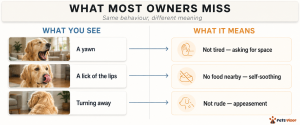
These are calming signals: small, easy-to-miss behaviours a dog offers to lower tension, both their own and yours. Think of them as a polite request rather than a problem.
6. Lip licking with no food around. A quick flick of the tongue over the nose when nothing is being eaten.
What to do: Look at what just changed. Someone leaned over them, a stranger reached out, the room got louder. Create a little space and the licking usually stops on its own.
7. Yawning when not tired. A wide yawn in the middle of a training session, a vet waiting room, or while a child hugs them.
What to do: Context decides everything here. A yawn at bedtime is just tired. A yawn while a stranger leans in is a request. Give them an exit and watch whether they take it.
8. Head turn or looking away. Your dog deliberately turns their face from something. This is appeasement, not rudeness.
What to do: Respect it. Stop the approach, back off slightly, let them re-engage on their own terms. This one signal, honoured consistently, does more for trust than almost anything else.
9. Whale eye. The head turns away but the eyes stay locked on something, showing white crescents at the corner.
What to do: This is a real one. Whale eye means the dog is conflicted — wanting to monitor a threat while trying to disengage from it. Increase distance immediately. Don’t reach toward them.
10. Paw lift. One front paw raised and held. In pointing breeds this can be hunting behaviour, but outside that context it usually means uncertainty.
What to do: Slow everything down. Something in the situation is unclear to them. Give them a beat to work it out rather than pushing forward.
11. Sudden sniffing or scratching. Your dog abruptly finds something fascinating on the ground, or stops to scratch, for no reason you can see.
What to do: These are displacement behaviours — a way of coping with an uncomfortable moment. Note what was happening right before it, because that’s your actual trigger.
12. Shake-off when not wet. That full-body shake dogs do after a bath, but with no water involved.
What to do: This is a reset button. Your dog is discharging tension. It’s actually a good sign — they’re processing something and letting it go. Give them a moment before asking anything else of them.
Warning Signals — Stop and Give Space
13. Body freeze. Everything stops. The dog goes completely still, sometimes mid-motion, often while still holding a wag.
What to do: Stop moving toward them. A freeze is one of the last quiet warnings before something louder. This is especially important around food, toys, or a resting spot.
14. Hard, unblinking stare. Direct eye contact held with a stiff, still body. This is a threat signal in dog language.
What to do: Look away and create distance calmly. Don’t stare back — that reads as a challenge. Teaching children never to stare into a dog’s eyes is one of the most important safety lessons there is.
15. Raised hackles. The hair along the back and neck stands up. This isn’t automatically aggression — it’s an involuntary arousal response, the same as human goosebumps.
What to do: Read the rest of the body before reacting. Raised hackles with a loose wiggly body means excitement. Raised hackles with a stiff posture and hard stare means back off.
How Do Dog Body Language Signals Escalate?
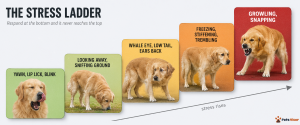
They climb a ladder, and it’s remarkably predictable.
At the bottom sit the smallest cues — a yawn, a lip lick, a blink, a head turn. If the discomfort doesn’t get resolved, the dog moves up: looking away, sniffing the ground, moving in a curve. Then whale eye, a low tail, ears back, a lifted paw. Then freezing and trembling. Then growling and showing teeth. Then snapping.
Here’s what that means practically. Every bite that supposedly came out of nowhere had a story before it. There was a lip lick. There was a head turn. There was a body that stiffened while everyone assumed the dog was fine.
Respond at the bottom rung and a dog almost never needs to climb toward the top.
Never Punish a Growl
This one is worth saying plainly. A growl is information — your dog telling you they’re near the end of what they can handle.
Punish the growl and you don’t remove the feeling. You remove the warning. What you end up with is a dog who skips straight from quiet discomfort to snapping, with nothing in between.
Thank the growl. Then figure out what caused it.
What Should You Do When You Spot Stress Signals?
Three things, in order.
Create distance first. Not comfort, not correction — space. Most stress signals are a request for room, and room is the one thing you can give instantly.
Then remove the trigger if you can. Move the visitor back, take the toy out of the equation, step away from the other dog. If you can’t remove it, remove your dog.
Then let them reset. Don’t fuss over them or apologise in a high voice. Just be calm and boring for a minute. A dog whose owner stays steady recovers much faster than one whose owner gets anxious about the anxiety.
Take BEAR, a golden retriever I watched for a while. Every time guests arrived she’d yawn repeatedly and drift toward the hallway. Her owner read it as her being sleepy and kept calling her back into the room. Once she started letting BEAR go to the hallway instead, the yawning stopped within two visits. BEAR wasn’t tired. She was asking for a door.
For dogs who need help settling on a regular basis, a few things genuinely earn their place. A ThunderShirt Classic Dog Anxiety Jacket applies steady pressure that works on the same principle as swaddling. An Adaptil Calm Home Diffuser releases a synthetic version of the pheromone a mother dog produces. And a snuffle mat like the PAW5 Wooly Snuffle Mat gives them sniffing work, which lowers heart rate faster than most people expect.
None of these replace addressing the trigger. They just make the recovery easier.
Which Dog Body Language Signals Are Most Often Misread?
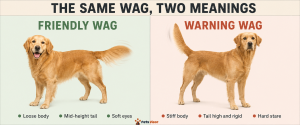
Four of them, consistently.
The wagging tail. Position and speed change the meaning completely. A loose, wide, mid-height wag is friendly. A stiff, fast wag held high is arousal, not welcome. Research also suggests dogs wag more to their right when they feel positive about something, and more to the left when they don’t.
The yawn. Almost always read as tiredness. Very often it’s a calming signal instead.
Showing teeth. Some dogs offer a submissive grin — teeth visible, body loose, whole rear end wiggling. It looks alarming and means the opposite. Teeth on a stiff body with a hard stare is the serious version.
The belly roll. Often read as an invitation for a belly rub. Sometimes it is. Sometimes it’s appeasement — a dog trying to defuse a situation by making themselves as non-threatening as possible. Loose body means rub away. Tense body means give them space.
Notice how often the answer comes down to the same thing? Loose versus stiff. That single distinction resolves more confusion than any list of individual signals ever will.
Sleep posture works the same way — what your dog’s sleeping position reveals about how they feel is body language reading in a different context.
I walked through the most commonly missed signals in a video, including the ones that show up seconds before a dog reacts:
Frequently Asked Questions
What does whale eye mean in dogs?
Whale eye is when your dog turns their head away from something but keeps their eyes fixed on it, showing white crescents at the corners. It signals conflict — they want to monitor whatever is worrying them while also trying to disengage. It’s a clear request for space, and it often appears just before a dog escalates to growling. Increase distance rather than reaching toward them.
Why does my dog yawn when they’re not tired?
Yawning is one of the most common calming signals dogs use. When it happens in a tense moment — a busy vet waiting room, a training session, or while someone leans over them — it’s a way of releasing tension and signalling that they mean no harm. Context is what separates the two. A yawn at bedtime is just tired. A yawn while a stranger reaches for them is a request for room.
How do I know if my dog is stressed?
Look for a cluster of at least three signals appearing together rather than any single one. Common early indicators are lip licking with no food present, yawning when not tired, turning the head away, sudden sniffing or scratching, panting in a cool room, and a tucked or lowered tail. If those escalate to whale eye, freezing, or a hard stare, the dog has moved well up the stress ladder and needs immediate space.
Does a wagging tail always mean a happy dog?
No. A loose, sweeping wag at roughly spine height usually does mean a relaxed, friendly dog. But a stiff, fast wag held high signals arousal or tension, and a low slow wag tucked toward the belly signals fear. The tail tells you how intensely a dog feels something, not whether that feeling is good. Read the rest of the body to find out which.
Should I punish my dog for growling?
Never. A growl is your dog communicating that they’re at the limit of what they can tolerate, and it’s genuinely useful information. Punishing it teaches the dog to skip the warning, not to stop feeling uncomfortable — which is how you end up with a dog who appears to snap without warning. Acknowledge the growl, create distance, and work out what caused it.
Reading Your Dog From Tonight Onward
Learning dog body language signals isn’t about memorising fifteen definitions. It’s about one habit: looking at the whole dog instead of one part, and finding three signals that agree before you decide anything.
Start with loose versus stiff. That single distinction will carry you further than any chart. Once you know what relaxed looks like on your particular dog, the moment it disappears becomes impossible to miss.
Your dog has been sending these signals every day of their life. They’ve just been waiting for someone to notice.
If you want to go deeper, the American Kennel Club’s guide to reading canine body language covers the anatomy of each signal in detail, and Pet Partners has a useful breakdown of how therapy animal handlers read stress in real time.
Which signal did you realise your dog has been doing all along? Drop their name in the comments and tell me — I read every one.