
This post contains affiliate links. As an Amazon Associate, I earn from qualifying purchases.
📌 TL;DR
- A wagging tail does not automatically mean a happy dog — speed, height, stiffness, and direction each carry completely different signals.
- Science has confirmed that the direction a dog wags — right vs. left — reflects which side of the brain is active, and other dogs read this instantly.
- A stiff, high, slow wag can signal aggression or alertness — not friendliness — and misreading it is how bites happen.
- Reading dog tail wag meaning correctly means watching the whole body, not just the tail in isolation.
You see a wagging tail and your brain says: happy dog, safe to approach. That instinct is so deeply wired it’s almost automatic. And it’s wrong often enough to matter.
Dog tail wag meaning is not a simple happiness meter — it’s a complex, multi-variable signal system that changes based on speed, position, stiffness, and even which direction the tail swings. Getting it right keeps you safer, builds a stronger bond with your own dog, and helps you understand what they’re actually saying in any given moment. Here’s the full breakdown.
Why Dogs Wag Their Tails in the First Place
Puppies don’t wag their tails at birth. The behavior emerges around three to four weeks old, at the point when they begin interacting socially with littermates and their mother. That timing isn’t coincidental — tail wagging is a communication tool, not a reflex. It developed because dogs are intensely social animals who needed clear, visible ways to signal their intentions to others.
A moving tail is an extraordinarily effective visual signal. Dogs’ eyes are highly sensitive to movement, which means a wagging tail registers immediately and across distance. Over thousands of years of living alongside humans, dogs have also adapted their tail communication to work with us — extending a system originally designed for other dogs into a cross-species language that most of us only partially understand.
Here’s the thing that changes everything: a wagging tail simply means arousal — an emotional activation of some kind. That arousal can be positive or deeply negative. The tail is the signal that something is happening emotionally. What that something is requires reading three more variables: position, speed, and direction.
Dog Tail Wag Meaning by Position: Where the Tail Sits Changes Everything
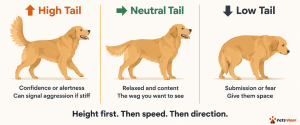
Tail height is the first thing to read, and it’s the variable most people miss entirely because they’re focused on the movement rather than where it’s happening.
High Tail — Confidence, Alertness, or Aggression
A tail held high — above the dog’s back line — indicates elevated arousal and confidence. In some contexts, this is perfectly fine: a dog who spots a squirrel and goes rigid with tail up is excited and focused. But a tail held very high and stiffly while the dog stares at a stranger or another dog is alertness sliding toward aggression. The higher and stiffer the tail, the more dominant and potentially threatening the signal. This is one of the most commonly misread wags — the dog looks active and engaged, the tail is moving, and people assume it’s positive. Not always.
Neutral Tail — Relaxed and Content
A tail held at roughly the dog’s natural resting height, wagging in a loose, wide sweep that moves the dog’s hips along with it — this is your happy dog. The whole back end is involved. There’s no tension. This is what genuinely relaxed, friendly arousal looks like in tail language.
Low Tail — Submission, Uncertainty, or Fear
A tail tucked between the legs signals submission or fear. A tail held just below the natural position, wagging in short, tight movements, signals insecurity — the dog is uncertain, possibly anxious, and not feeling confident in the situation. In my experience, this low uncertain wag is the one owners most often misread as “shy but friendly” when it actually means “I’m not comfortable and may need support right now.”
Dog Tail Wag Meaning by Speed and Stiffness
Speed tells you how activated the dog is. Stiffness tells you what kind of activation it is.
Fast and Loose — Excited and Positive
A fast, wide, loose wag — the whole tail sweeping broadly, body moving with it — is enthusiastic happiness. Your dog greeting you after a long day. The “helicopter tail” (tail moving in a full circular motion) is the maximum version of this, typically reserved for the people and dogs a dog loves most. If you’re getting a helicopter tail, that greeting is genuine and specific to you.
Slow and Deliberate — Uncertainty or Assessment
A slow wag, tail moving in short, measured strokes, means your dog is processing. They’re uncertain about a person, a sound, or a situation and are gathering information before deciding how to proceed. It’s not aggression. It’s not fear. It’s caution — and it deserves to be read as such rather than pushed past.
Fast and Stiff — Arousal That Could Go Either Way
This is the dangerous combination that causes most tail-wag misreadings. A fast wag paired with a stiff, rigid tail and a tense body is not happiness — it’s high arousal with an uncertain or negative edge. The movement speed reads as enthusiasm. The stiffness and body tension read as threat or extreme focus. A dog who is about to lunge, charge, or bite can absolutely be wagging their tail while doing it. Speed alone is not a green light.
The Hidden Signal: Why the Direction of the Wag Actually Matters
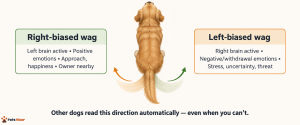
This is the piece of dog tail wag meaning that most people have never heard of — and it’s backed by some of the most interesting research in canine behavior science.
Research published in a peer-reviewed journal found something remarkable: dogs wag their tails with a bias toward the right side of their body when they’re experiencing positive emotions — seeing their owner, anticipating something good. When facing something they want to move away from — an aggressive unfamiliar dog, an uncomfortable situation — the wag shifts to a left-side bias.
The reason is neurological. The left side of the brain (which controls right-side body movement) is associated with positive approach emotions. The right side of the brain (which controls left-side movement) is associated with withdrawal and negative emotional states. The tail direction is a direct readout of which hemisphere is more active.
Here’s what makes this even more extraordinary: other dogs read this signal. The same research team found that when dogs were shown videos of dogs with right-biased tail wags, they stayed relaxed. When shown left-biased wags, their heart rates increased and they showed anxious behavior — even though the movement looked superficially the same to human observers. Dogs decoded the emotional signal from the direction alone, automatically and immediately.
Take Bear, a 4-year-old golden retriever I know well — his owner noticed he’d become hesitant and slightly tense around a neighbor’s dog even though that dog “always wagged.” Once she started watching more carefully, she realized the other dog’s wag was consistently tight and slightly left-biased when Bear approached. Bear had been reading it correctly for months. She just hadn’t known to look.
As a human, spotting left vs. right direction bias in real time is genuinely difficult — but you can train yourself to notice it at the extremes. And knowing it exists changes how you interpret your dog’s reactions to other dogs, even when you can’t read the wag direction yourself.
Understanding the direction bias connects directly to reading your dog’s broader emotional state — just as your dog’s sleeping position reveals which emotional state they settle into most naturally.
The 6 Most Common Wag Types and What They Actually Mean
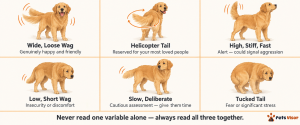
After years of watching dogs do this, these are the six patterns worth knowing cold:
- Wide, loose, full-body wag at neutral height: Genuinely happy and friendly. The body moves with the tail. This is what you’re hoping to see.
- Helicopter tail (circular motion): Extreme positive excitement, usually reserved for specific beloved people or dogs. A compliment if you’re getting it.
- High, stiff tail with short fast wags: Alert and potentially aggressive. Do not approach an unfamiliar dog showing this. Read the rest of the body carefully.
- Low, short, tight wag below neutral position: Insecurity or uncertainty. The dog is not comfortable and may need distance or support.
- Slow, deliberate, mid-height wag: Cautious assessment. The dog is thinking. Don’t push the interaction — let them take their time.
- Tucked tail with minimal movement: Fear or significant submission. The dog is stressed. Give them space and don’t force engagement.
I’ve seen this with so many dogs: the wag that worries me most is the high, stiff, fast one that owners read as enthusiasm. That dog is highly aroused and the outcome is genuinely uncertain until you read the whole body alongside it.
Why You Must Always Read the Tail Alongside the Rest of the Body
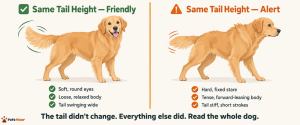
The tail is one channel in a multi-channel communication system. Reading it in isolation is like reading one word out of a sentence. The meaning shifts entirely depending on what else is happening.
A tail at neutral height with a relaxed face, soft eyes, and a loose body = relaxed and friendly. The same tail position with a hard stare, stiff body, and raised hackles = something very different. The tail didn’t change. Everything else did.
The signals to read alongside the tail: ear position (forward and rigid vs. soft and slightly back), facial tension (hard vs. soft eye, closed tight mouth vs. relaxed open mouth), body posture (leaning forward vs. neutral vs. slightly back), and whether the hackles along the spine or shoulders are raised.
Once you start reading the whole picture together, dog tail wag meaning becomes dramatically clearer — and you’ll find yourself catching signals you used to miss entirely. If you want to build this skill further, understanding why dogs stretch is another layer of body language that reveals how they’re transitioning between emotional states.
For owners who want to deepen this understanding systematically, books like Canine Body Language: A Photographic Guide by Brenda Aloff are excellent reference tools — highly visual, practical, and genuinely used by professional trainers and behaviorists.
The Wikipedia overview of tail wagging research also provides a useful summary of the peer-reviewed studies behind the direction bias findings for anyone who wants to go deeper on the science.
Frequently Asked Questions
What does it mean when a dog wags its tail slowly?
A slow wag typically signals uncertainty or careful assessment rather than happiness. Your dog is processing the situation — a new person, an unfamiliar environment, or something that’s caught their attention — before deciding how to feel about it. It’s not aggression, and it’s not fear. It’s caution. The right response is to give them time rather than pushing the interaction forward. If the slow wag is paired with a low tail position, it leans more toward insecurity or submission.
Why does my dog wag its tail to one side?
The direction of the wag reflects brain hemisphere activation. A right-biased wag (tail swinging more to your dog’s right) indicates positive emotional activation — your dog is approaching something they feel good about. A left-biased wag reflects the opposite hemisphere and is associated with withdrawal or negative emotional states. Research has confirmed that other dogs read this direction instinctively. As a human observer, it can be difficult to detect in real time, but it becomes noticeable at the extremes.
Can a wagging tail mean a dog is aggressive?
Yes — and this is one of the most important things to understand about dog tail wag meaning. A high, stiff tail wagging in short, fast strokes paired with a tense body and hard stare can signal aggression or a dog on the edge of aggression. The wag indicates high arousal, not friendliness. Dogs have bitten while wagging their tails. Never approach an unfamiliar dog based on tail wagging alone — always read the full body posture before deciding it’s safe to interact.
What does a helicopter tail wag mean?
A helicopter tail — where the tail moves in a full circular rotation rather than side to side — is the highest expression of enthusiastic, positive excitement in dog body language. It’s typically reserved for the people and dogs a dog is most bonded to. If your dog gives you a helicopter tail greeting, it means they’re genuinely thrilled to see you specifically. It’s considered one of the most unambiguously positive signals in canine communication.
What does it mean when a dog wags its tail but won’t approach?
This is a conflict signal — your dog is emotionally activated (hence the wag) but uncertain or ambivalent about approaching. The tail wag reflects arousal; the reluctance to move forward reflects caution or low-grade fear. This is most common in dogs who are curious but not confident, or who want to interact but feel unsure whether it’s safe. Don’t interpret the wag as an invitation to push the interaction — let the dog close the distance on their own terms when they’re ready.
Understanding dog tail wag meaning properly is one of the most practical things you can do as a dog owner — it changes how you read your own dog, how you approach unfamiliar dogs, and how clearly you can respond to what your dog is actually communicating in any given moment. The tail is never just one thing. Position, speed, stiffness, and direction each carry their own signal, and the real message is in how they combine.
Once you start reading all four variables together — and watching the rest of the body alongside the tail — you’ll catch signals you used to miss entirely. For more on reading your dog’s quiet, everyday communication, your dog’s sleeping position is another window into their emotional world that most owners completely overlook.
Does your dog have a signature wag you’ve noticed — the helicopter, the cautious slow sweep, or something else entirely? Drop it in the comments. I’d love to hear which one yours goes for most.