
This post contains affiliate links. As an Amazon Associate, I earn from qualifying purchases.
📌 TL;DR
- Dogs show 5 key behaviors when they see you as their parent — but a few of them have a “too much” version that signals anxiety, not just love.
- Science backs this up: the “secure base effect” proves dogs bond with owners the same way human infants bond with parents.
- Soft eye contact, seeking comfort, bringing you toys, following you, and mirroring your mood are the clearest signs — but context always matters.
- Strengthening this bond is simple, and it doesn’t require expensive gear — just consistent, calm presence.
Your dog follows you to the bathroom. They drop a soggy tennis ball in your lap like it’s a precious gift. They press their whole body against your legs during a thunderstorm. And you’ve probably wondered — do they actually think of me as their parent?
Yes. And the science agrees. The signs your dog considers you their parent go far beyond loyalty — they’re wired into your dog’s biology. But here’s what most articles don’t tell you: a few of these “sweet” signs can cross a line into something that needs attention. Knowing the difference matters.
What Does the Science Say About Dogs Seeing You as a Parent?
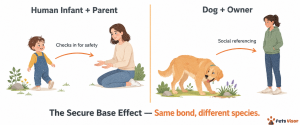
Before we get into the specific behaviors, it helps to understand why this happens in the first place. Researchers at the University of Veterinary Medicine in Vienna studied what’s called the “secure base effect” — a concept borrowed from child psychology. In human infants, a secure base is the parent: that one safe person children use as an anchor when they explore the world.
The Vienna study tested dogs in three conditions — with an encouraging owner, with a silent owner, and with no owner at all. Dogs were far more motivated and confident when their owner was present. Repeat the same test with a stranger? The effect disappeared. It’s specific to you. Not just any human. You.
A 2015 study published in Science also found that sustained eye contact between dogs and their owners triggers an oxytocin feedback loop — the same bonding hormone released between a mother and her newborn. That’s not a coincidence. That’s co-evolution doing its thing.
So yes, your dog sees you as something close to a parent — not because they’re confused about species, but because their attachment system was shaped, over thousands of years, to attach deeply to you. Here’s what that looks like in real life.
Sign #1: They Follow You Everywhere — But There’s a Line
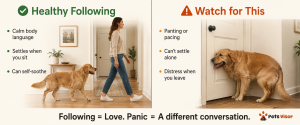
If your dog trails you from room to room like a furry shadow, that’s a classic sign of parental attachment. In my experience, this is the very first thing dog owners notice and smile about — and rightfully so. It means your dog trusts you, finds safety in your proximity, and genuinely wants to be near you.
Puppies do this with their mothers instinctively. Adult dogs do it with the person they’ve bonded to most. When your dog can’t seem to settle unless you’re in the room, it reflects that same deep, primal pull.
But here’s where it gets important. Is your dog following you calmly, then happily settling once you sit down? That’s healthy attachment. Is your dog panting, pacing, or showing distress the moment you move? That’s edging toward something worth paying attention to — separation anxiety can hide behind what looks like love.
The sweet spot: your dog chooses to be near you, but can also relax independently. If they can’t, tools like the Adaptil Dog Calming Diffuser can help take the edge off during training to rebuild that confidence.
Sign #2: They Bring You Their Toys or “Gifts”
Take Bear, my neighbor’s 3-year-old golden retriever mix — every single morning, without fail, she’d meet her owner at the front door with a shoe in her mouth. Not chewing it. Just… presenting it. Her owner thought it was quirky. It wasn’t quirky. It was a gesture.
When dogs bring you objects — toys, socks, sticks, whatever they can grab — they’re not being random. In the wild, this behavior signals trust and emotional investment. Dogs don’t share their prized possessions with just anyone. The fact that your dog is offering theirs to you says something real: you are their person.
Retrieving breeds do this more than others, but any dog can show this behavior. If your dog drops something at your feet and then looks up expectantly — not to play, just to share the moment — that’s a parent-child dynamic in action.
Want to see all 5 signs explained with real dog examples? I put together a video that walks through each one:
Sign #3: They Look to You for Guidance When Something Is New or Scary
This one is called social referencing — and it’s one of the most striking signs your dog considers you their parent, because it’s something researchers didn’t expect dogs to do at all.
Here’s what it looks like: your dog hears a strange noise, spots an unfamiliar object, or meets someone new. Instead of reacting immediately, they pause and glance at your face first. They’re checking your expression. If you look calm, they relax. If you tense up, they tense up too.
Human toddlers do the exact same thing. It’s how children learn to calibrate their emotional responses to the world — by reading their parent’s face. Your dog has developed the same skill, specifically with you. Not with strangers. With you.
After years of watching dogs do this, I’m still moved by it every time. It’s a form of trust that most people don’t fully recognize. Your dog isn’t looking to you for permission. They’re looking to you for emotional truth.
This is also why your anxiety affects your dog more than you’d think. Dogs are reading you constantly. The American Kennel Club notes that dogs are remarkably sensitive to human emotional cues — and this sign is exactly why.
Sign #4: They Run to You When They’re Scared
Thunder. Fireworks. The vacuum cleaner. A slamming door. Whatever sets your dog off — who do they run to?
If the answer is you, that’s one of the most direct signs your dog considers you their parent. You’re their safe place. Their emotional landing pad. And it’s not about being spoiled or overly sensitive — it’s about attachment theory working exactly as it should.
I’ve seen this with so many dogs: they’ll sprint past furniture, past other people in the room, and press themselves against the one person who means “safe” to them. That’s not random behavior. That’s a wired-in response to a trusted caregiver.
The key here is how you respond. Comforting your dog during fear doesn’t teach them to be fearful — that’s an old myth. What it does do is reinforce that you’re a reliable source of safety. Which is exactly what a good parent does. That said, if your dog’s fear is intense or triggered by everyday sounds, it’s worth talking to your vet. Products like Thundershirt Classic Dog Anxiety Jacket can offer real, immediate comfort while you work on the underlying triggers.
Curious about how your dog’s sleeping position connects to how safe they feel around you? This post breaks down what each sleep position actually means.
Sign #5: They Mirror Your Mood — Sometimes Before You’ve Even Noticed It Yourself
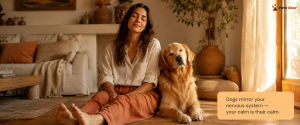
This one tends to catch people off guard. Have you ever been stressed — quietly, internally — and noticed your dog was suddenly restless, clingy, or couldn’t settle? That’s not a coincidence.
Dogs are emotional mirrors. Research shows they respond to our emotional cues — voice tone, body posture, even subtle hormonal changes in scent — in ways that reflect what we’re feeling. It’s called emotional contagion, and it’s the same mechanism that allows human parents and children to influence each other’s nervous systems.
A calm, grounded owner tends to have a calm dog. An anxious household often has an anxious dog. It doesn’t mean you’re doing something wrong — it means your dog is paying very close attention. Because in their world, you’re the one who sets the emotional temperature of the home.
What does a healthy version of this look like? Your dog checks in on you, settles when you settle, and relaxes fully when you’re relaxed. If your dog seems chronically stressed or is showing signs of anxiety even in calm environments, that’s a separate conversation worth having with a vet or behaviorist.
Frequently Asked Questions
Does my dog actually think I am their parent?
Not in the way a human child understands parenthood — but functionally, yes. Studies show dogs form a “secure base” attachment to their owners that mirrors the bond between human infants and their caregivers. Your dog relies on you for safety, emotional regulation, and guidance the same way a young child relies on a parent.
Why does my dog follow me everywhere I go?
Following behavior is a natural sign of attachment — your dog sees you as their safe base and wants to stay near you. It becomes a concern only when it’s paired with visible distress, like panting, whining, or destruction when you leave. Calm following is healthy. Panicked following may signal separation anxiety that’s worth addressing with your vet.
What does it mean when a dog brings you a toy?
It means you’re in their inner circle. Dogs don’t share their prized possessions casually — offering you a toy is a gesture of trust and affection. In retrieving breeds especially, it can also be a way of saying “I’m excited and I want to share this moment with you.” Either way, it’s a good sign.
Can a dog bond this deeply with more than one person in the household?
Yes, but there’s usually a primary attachment figure — the person who provides the most consistent care, feeding, and interaction. Other household members can absolutely be loved and trusted, but dogs tend to show the strongest parental-attachment behaviors toward one main person. That’s not exclusion; it’s just how deep bonding works.
Do dogs bond differently with adopted or rescue dogs compared to puppies raised from birth?
The timeline can differ — rescue dogs sometimes take longer to fully trust a new person — but the depth of attachment can be just as strong, and in some cases even deeper. Studies on former shelter dogs show they’re fully capable of forming the same secure base bond as dogs raised in a home from puppyhood. Patience and consistency are what matter most.
The five signs your dog considers you their parent aren’t just heartwarming — they’re rooted in real attachment science. When your dog follows you, seeks you out during fear, mirrors your emotions, brings you their treasures, or reads your face before deciding how to feel, they’re showing you something profound: you are their safe place in the world.
Just remember: these signs are healthiest when they coexist with your dog’s ability to relax independently too. Love and trust, not dependency, is the goal. And if you want to understand even more of what’s happening inside your dog’s head, understanding why dogs stretch is another surprisingly revealing window into how they communicate.
Which of these five signs does your dog show the most? Drop it in the comments — I’d love to hear.