
This post contains affiliate links. As an Amazon Associate, I earn from qualifying purchases.
📌 TL;DR
- When your dog puts paw on you, it’s intentional communication — but the meaning changes completely depending on the style, pressure, and body language that comes with it.
- A gentle resting paw, an insistent tapping paw, and a pushing paw are three very different messages — and most owners treat them all the same.
- A raised paw that doesn’t land is actually a stress signal, not a request for play — and missing that difference matters.
- Most pawing is positive, but sudden or compulsive pawing paired with other symptoms deserves a closer look.
Your dog puts paw on you while you’re watching TV — gently, softly, like they just want to be close. Sweet, right? Maybe. But that same dog might press their paw into your leg with real force an hour later — and that’s a completely different conversation.
When a dog puts paw on you, it’s one of the most direct forms of communication they have. And while most of it is affection or a simple request, reading how they do it tells you far more than the gesture alone. Here’s what’s actually going on.
Why Your Dog Puts Paw on You: The 7 Real Reasons
Pawing isn’t random. Dogs learn early — sometimes as puppies nudging their mother — that physical contact gets results. By the time your dog is an adult, they’ve refined this into a surprisingly specific communication tool. The reasons below cover the full range, from the warmest to the ones worth taking seriously.
1. Pure Affection — The Canine Version of a Hand on Your Shoulder
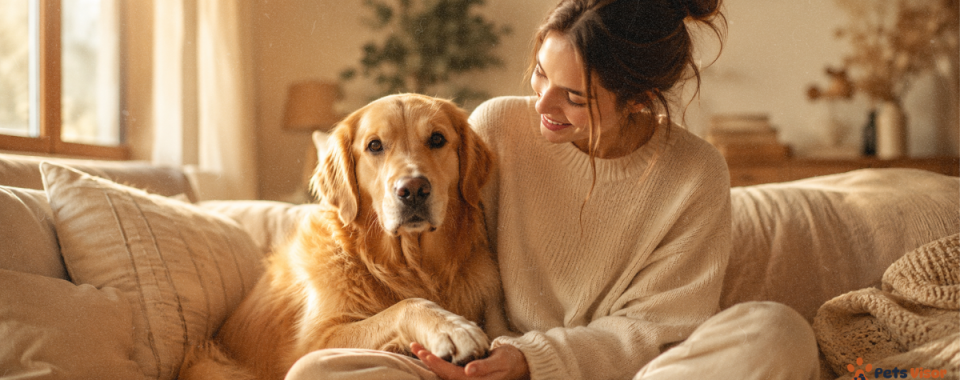
The most common reason, and often the most misread. When your dog puts paw on you softly — no pressure, no urgency, just contact — that’s affection. Dogs don’t have hands, so physical touch is one of the main ways they close the emotional distance between themselves and someone they love. Research shows that mutual touch between dogs and their owners triggers oxytocin release in both parties — the same bonding hormone involved in human parent-child contact. Your dog isn’t just being cute. They’re doing something biologically meaningful.
2. Attention-Seeking — And It Works, Which Is Why They Keep Doing It
Here’s the behavioral loop that creates most persistent pawers: your dog puts paw on you, you look over, you pet them, they paw again. Done. They’ve trained you. Applied behavior analysts call this “manding” — a request or demand — and dogs figure it out fast because pawing is almost impossible to ignore. Physical contact gets a reaction nearly every time. If you’ve ever responded to a paw-tap on your phone-holding hand by giving your dog a scratch behind the ears, congratulations: you’ve reinforced the behavior. This isn’t a problem unless it becomes relentless or demanding — more on that below.
3. “Keep Going” — The Paw as a Pause Button Override
You’re petting your dog. You stop. Their paw comes down on your hand. This one is almost universally misunderstood as pushiness, when actually it’s one of the clearest and most direct things your dog can say: don’t stop. It’s reciprocal communication — your dog is essentially petting you back while asking you to continue. In my experience, this is the most endearing version of the dog puts paw on you behavior, and it comes almost exclusively from dogs who feel completely relaxed and comfortable with you.
4. A Practical Request — Hunger, Potty, Playtime
Sometimes a paw is just a question. “Are you aware it’s been three hours since my dinner?” Dogs who’ve learned that pawing gets a response will use it for practical needs: it’s dinnertime, the water bowl is empty, they need outside. The tell is usually timing. If your dog paws you at roughly the same time every day, or right before their usual walk or mealtime, they’re being remarkably communicative — not demanding. They’re doing the canine equivalent of tapping you on the shoulder.
5. Stress or Anxiety — When the Paw Is Actually a Cry for Help
This is the one most owners miss entirely. When a dog puts paw on you during a thunderstorm, before a vet visit, or when strangers arrive — that’s not affection. That’s a stress response. Your dog is reaching for stability. They’re using physical contact to self-soothe, the same way a child reaches for a parent’s hand in a crowd.
Take Bear, a 4-year-old golden retriever I know well — his owner thought his constant pawing during family gatherings was excitement. Once we looked at the full picture — tense jaw, low tail, ears slightly back — it was clear Bear was overwhelmed and using the paw to anchor himself to his person. The guests thought it was adorable. Bear was asking to leave.
If your dog’s pawing is connected to specific triggers, calming tools can help bridge the gap. Products like the Thundershirt Classic Dog Anxiety Jacket or Adaptil Calm Home Diffuser work well alongside behavioral support for dogs whose stress pawing is consistent.
6. Empathy — When They Know Something Is Wrong With You
Dogs are remarkably good at reading human emotional states — studies show they can distinguish happy from sad faces and respond differently to each. When you’re upset, stressed, or crying, some dogs will place a paw on you in a way that feels unmistakably intentional. No urgency, no demand — just presence. This type of pawing tends to be slow, gentle, and often accompanied by sustained eye contact. After years of watching dogs do this, I’m convinced it’s one of the most genuinely empathetic behaviors they show. They can’t fix what’s wrong. But they’re not leaving your side either.
7. Habit — Because It Once Worked, and Now It’s Just What They Do
Not every paw means something deep. Some dogs paw because at some point, months or years ago, pawing produced something good — a treat, a reaction, a laugh — and the behavior stuck. If your dog puts paw on you almost reflexively, without apparent need or emotion attached, it may simply be a learned habit. That doesn’t make it less affectionate, exactly, but it does mean it doesn’t require the same response every time.
Want to see how to read these different types of pawing in real dogs? This video breaks it down clearly:
What the Paw Style Tells You When Your Dog Puts Paw on You
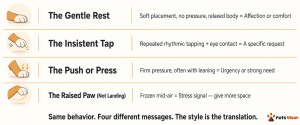
Here’s the piece that almost nobody talks about — and it’s the most useful thing in this entire article. The style of the paw tells you more than the paw itself.
The Gentle Rest
Paw placed softly, no movement, relaxed body. This is affection or comfort-seeking — your dog is choosing physical closeness. Respond however feels natural. There’s nothing to redirect here.
The Insistent Tap
Repeated, rhythmic tapping, often with some eye contact and maybe a whine. This is a request — practical or social. Your dog has something specific they want. Check the usual suspects: food, water, outside, attention. Respond to the need, but if it happens constantly, redirecting to a “sit” before you respond helps prevent the habit from becoming demanding.
The Push or Press
Paw placed with real pressure, possibly accompanied by leaning into you. Can be affection in a very physically connected dog, or it can signal urgency — stress, pain, or a strong unmet need. Read the rest of their body before deciding how to respond.
The Raised-But-Not-Landing Paw
This one matters and gets almost no attention. A dog who lifts their paw partway — as if they were about to make contact but didn’t complete the gesture — is typically showing stress or internal conflict. It’s a classic “freeze” body language signal. If you see this in a new environment, around unfamiliar people, or during something your dog finds uncomfortable, it’s a sign to create more space and ease, not more engagement.
Understanding these paw types connects directly to reading your dog’s broader body language — just like how your dog’s sleeping position reveals exactly how comfortable and safe they feel.
When Your Dog Puts Paw on You — Should You Respond or Redirect?
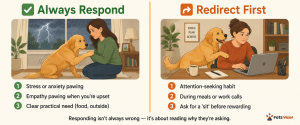
This is where a lot of owners get stuck. Responding to every paw feels like the kind thing to do. But responding every single time — regardless of context — teaches your dog that pawing is a guaranteed access code to whatever they want.
The answer isn’t to ignore your dog or shut down their communication. It’s to respond thoughtfully. Here’s a simple framework:
- Stress or anxiety pawing: Always respond. Your dog needs you in that moment, and responding builds the trust that helps them handle stress better over time.
- Empathy pawing: Always respond. This is your dog being emotionally present for you. Meet that.
- Practical request pawing: Respond once you’ve confirmed the need — but if it’s becoming constant, teach a replacement behavior like ringing a bell for outside rather than reinforcing the paw.
- Attention-seeking or habit pawing: Respond selectively. Ask for a sit first, then give the attention. This keeps the communication healthy without letting it become demanding.
I’ve seen this with so many dogs: owners who respond to every paw eventually end up with dogs who paw them dozens of times a day. The love is real — but some structure makes the relationship better for both of you.
If your dog’s pawing is constant and compulsive rather than communicative, it’s worth a vet conversation. Sudden increases in pawing, especially paired with restlessness, whining, or changes in appetite, can sometimes signal physical discomfort or an anxiety condition worth addressing properly. The ASPCA notes that compulsive attention-seeking behaviors are often linked to underlying anxiety that benefits from professional behavioral support.
Should You Discourage It When Your Dog Puts Paw on You?
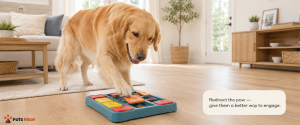
Honestly, for most dogs in most situations? Manage it, don’t eliminate it. Pawing is one of the cleaner, more polite ways your dog has of communicating, and shutting it down completely often just forces them to find louder alternatives — barking, jumping, nudging with their nose.
What’s worth discouraging: repeated insistent pawing during meals, work calls, or when guests are present. The most effective approach is to completely withdraw attention the moment it starts — no eye contact, no voice, no touch — then immediately reward with attention the moment your dog offers a calmer behavior like sitting or lying down.
If pawing has become a big, scratchy, jumping-paws situation rather than a gentle gesture, interactive puzzle toys like the Nina Ottosson Dog Tornado Puzzle Toy can redirect that physical energy and give your dog a satisfying way to engage without targeting you directly.
And if your dog tends to put paw on you right after stretching or waking up, there’s often a simple physical explanation — understanding why dogs stretch reveals a lot about how they transition into active engagement with their people.
Frequently Asked Questions
What does it mean when a dog puts paw on you?
It depends on how they do it and what the rest of their body is saying. A soft, resting paw usually signals affection or comfort-seeking. A tapping or insistent paw is a request — for attention, food, or something practical. A paw during a stressful moment is your dog reaching for reassurance. The gesture itself is always intentional; the meaning shifts with context, pressure, and body language.
Why does my dog paw at me while I pet them?
Almost certainly they’re saying “don’t stop.” When you’re petting a dog and they place their paw on your hand or arm, it’s a reciprocal gesture — they’re returning the physical contact and signaling they want more. It’s one of the most direct and relaxed forms of canine communication, and it only happens with dogs who feel genuinely comfortable with you.
Why does my dog put his paw on me and stare?
The paw-plus-stare combination is one of the strongest attention-seeking signals a dog uses. They’re making physical contact to get your focus, then holding your gaze to maintain it. If it’s calm and soft, they likely want affection or are checking in emotionally. If it’s intense and persistent, they have a specific unmet need — check food, water, or whether they need to go outside.
Is it okay to let my dog put their paw on me?
Generally yes — it’s a natural and often sweet form of communication. The exception is if it’s becoming physically uncomfortable (large dogs with heavy paws can scratch skin or damage clothing) or if it’s escalating into demanding behavior. In those cases, a gentle redirect to a “sit” before giving attention keeps the communication healthy without eliminating it altogether.
Why does my dog paw at me when I stop petting them?
This is called “manding” in behavioral terms — your dog has learned that pawing gets them something they want, and they’re using it to ask you to continue. It’s not problematic in itself, but if you always comply immediately, you reinforce the pattern. A good middle ground: pause, let your dog settle for a few seconds, then continue petting if you want to. This keeps the behavior from escalating into demands.
Every time your dog puts paw on you, they’re doing something intentional — reaching out with one of the few physical tools they have to connect, ask, comfort, or be comforted. Most of the time, it’s one of the nicest things they do. The key is learning to read what style of paw you’re getting, and what the rest of their body is telling you at the same time.
Context always wins over the gesture alone. And once you start reading it correctly, you’ll realize your dog has been having full conversations with you all along — you just didn’t have the translation yet. For more insight into how dogs communicate through quiet physical signals, your dog’s sleeping position is another surprisingly telling window into how they’re really feeling.
Does your dog have a signature paw move — the gentle rest, the insistent tap, or the full-on stare-and-paw combo? Drop it in the comments. I’d love to hear which one yours goes for.