
This post contains affiliate links. As an Amazon Associate, I earn from qualifying purchases.
📌 TL;DR
- Many everyday things that stress your dog are things you’d never suspect — hugging, eye contact, scented candles, even your own bad mood.
- The key isn’t just knowing the triggers — it’s recognizing the exact body language signal your dog shows in that moment.
- Most stress responses are subtle: lip licking, yawning, turning away, and a tucked tail are easy to miss but important to catch early.
- Small changes to your daily routine can significantly reduce your dog’s background stress — and a calmer dog is a healthier, happier one.
You’re doing everything right — walks, meals, playtime, lots of love. So why does your dog still seem on edge some days? The truth is, some of the most common things that stress your dog are things you’re doing without realizing it, inside your own home, every single day.
The everyday things that stress your dog aren’t always loud or dramatic. Some are as quiet as a scented candle or as well-intentioned as a hug. Here are the 10 most common hidden stressors — and the specific signs your dog is showing you right now that you might be misreading as something else entirely.
1. Hugging — The Human Gesture Dogs Don’t Speak
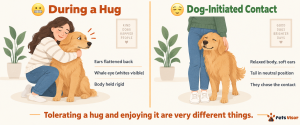
Hugging is one of the most well-documented things that stress your dog, and also one of the hardest for owners to accept. A behavioral study analyzing hundreds of photos of people hugging dogs found that over 80% of dogs showed visible stress signals during the embrace — flattened ears, half-moon eyes, turned heads, lip licking. Not aggression. Not displeasure. Quiet, polite stress.
Dogs aren’t built for being held still by another body. In the animal world, restraint signals danger. Your dog may tolerate a hug because they love and trust you deeply — but tolerating something and enjoying it are very different things.
What your dog actually does: looks away, licks their lips, holds their body very still, or shakes off immediately when released — that “shake-off” is a real stress reset behavior.
Try sitting close and letting them lean into you on their own terms instead. That contact feels safe because they chose it.
2. Prolonged Direct Eye Contact — It Reads as a Challenge
You look into your dog’s eyes thinking it’s a bonding moment. To a dog, unblinking prolonged eye contact is a dominance signal — a challenge, or at minimum, something uncomfortable. Soft, relaxed glances are fine. Locking eyes without blinking? That’s a different message in their language.
In my experience, owners are often surprised by this one because it feels so counterintuitive. You’re trying to connect. Your dog is politely trying to tell you it’s too much.
What your dog actually does: looks away, yawns, licks their lips, or turns their head to the side. These are all calming signals — your dog is trying to de-escalate what they’re reading as tension.
3. Your Own Stress — They Smell It Before You Show It
Dogs can detect cortisol — the human stress hormone — through scent alone. Studies confirm that dogs respond differently to their owner’s emotional state even when the owner is trying to appear calm. Your body chemistry shifts when you’re anxious, and your dog reads that shift before your face does anything.
Take Bear, a 3-year-old golden retriever I know well — every time his owner had a stressful work week, Bear would become clingy and unsettled by Wednesday, even though the household routine hadn’t changed at all. The owner thought Bear was “picking up on something outside.” Bear was picking up on her.
What your dog actually does: becomes suddenly clingy, follows you room to room more than usual, or starts panting and pacing in an otherwise quiet environment. These aren’t random — they’re mirroring.
4. Inconsistent Rules — Unpredictability Is Exhausting
Dogs thrive on knowing what to expect. When the rules shift — couch is fine today, scolded for it tomorrow; jumping gets a laugh from guests but a stern “no” from you — your dog can never fully relax. They’re constantly running calculations: what version of the rules applies right now?
After years of watching dogs do this, the chronic low-grade anxiety that comes from inconsistent rules shows up in dogs who seem perpetually unsettled. Not dramatic. Just never quite at ease. That’s exhausting over time.
What your dog actually does: hesitates before doing something they used to do freely, checks your face constantly before settling, or shows displacement behaviors like sniffing the floor or scratching themselves when there’s no obvious reason.
Here’s a video that walks through these hidden stressors with real dog examples:
5. Strong Household Scents — Your Dog’s Nose Is Working Overtime
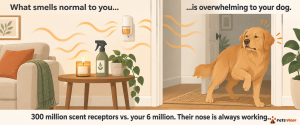
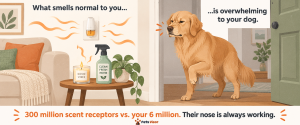
Dogs have roughly 300 million scent receptors. We have six million. An air freshener that smells mild to you is, to your dog, like walking into a room where someone is spraying perfume directly at face level — constantly. Scented candles, plug-in diffusers, heavily fragranced cleaning products, and essential oil diffusers are all common things that stress your dog that most people never connect to behavior changes.
What your dog actually does: avoids certain rooms without explanation, sneezes more than usual near specific areas, rubs their face on the carpet, or seems restless in a room that’s heavily scented. If your dog used to love the living room and now avoids it, check what’s changed in that room’s scent profile first.
When cleaning, opting for fragrance-free products where possible makes a real difference. The Rocco & Roxie Professional Strength Stain & Odor Eliminator is enzyme-based and unscented — effective without the chemical load that overwhelms a sensitive nose.
6. Leash Corrections and Pulling Away From Sniffs
Sniffing isn’t a distraction for your dog. It’s the entire point of the walk. Dogs process their world primarily through scent — a fire hydrant isn’t just a fire hydrant, it’s a full social feed of information about every dog who’s passed through in the last 24 hours. When you yank the leash and hurry them along, you’re interrupting the one activity that’s most mentally satisfying and genuinely decompressing for them.
Research on canine enrichment consistently shows that dogs allowed to sniff freely on walks show lower stress indicators once home than dogs who were kept moving at a human pace. A shorter walk with full sniff time is more beneficial than a longer walk on a tight leash.
What your dog actually does: pulls harder toward scents, becomes more agitated mid-walk rather than calmer, or arrives home still restless and unable to settle — signs the walk didn’t actually decompress them.
A front-clip harness like the PetSafe Easy Walk Harness gives you control without the neck pressure of collar corrections, making it easier to slow down and let your dog lead with their nose when it’s safe to do so.
7. Household Sounds You’ve Tuned Out
The microwave beeping. The smoke detector low-battery chirp. The washing machine spin cycle. The alarm clock. These sounds are so normal to you that you don’t register them anymore. Your dog hasn’t habituated to them the same way — and for noise-sensitive dogs, these unpredictable, high-frequency sounds keep them in a low-grade state of alertness all day without either of you realizing it.
The unpredictability is the real problem. Your dog can’t predict when the microwave will beep, which means their nervous system never fully settles between beeps. Chronic low-level arousal like this builds up over time into anxiety that looks like restlessness, clinginess, or difficulty settling — none of which seems obviously connected to a kitchen appliance.
What your dog actually does: startles easily, leaves the room when certain appliances run, can’t seem to relax in the kitchen or laundry area, or pants in a calm environment without apparent reason.
8. Being Approached While Eating or Sleeping
Dogs need to eat and sleep without the low-level worry that someone is going to appear in their space. Approaching a dog during these moments — especially reaching over them, staring at them while they eat, or waking them abruptly — activates a threat response that they have to manage and suppress. Over time, that management effort is draining.
I’ve seen this with so many dogs: they’re labeled “food aggressive” or “grumpy when woken up” when the real issue is that they’ve never been given space that feels genuinely safe and predictable. The dog isn’t being difficult. They’re being asked to stay calm while someone interrupts the one thing that should feel secure.
What your dog actually does: eats faster than necessary, guards their bowl without taking food away, stiffens when you walk nearby during a meal, or snaps when startled awake. All of these are context responses, not personality flaws.
Giving your dog a consistent, low-traffic feeding spot and respecting sleep goes a long way. A raised feeding station like the Neater Feeder Elevated Dog Bowls can help create a more defined, dedicated eating space that signals “this area is yours.”
9. Punishment After the Fact

You come home. Something is destroyed. You raise your voice and point at the mess. Your dog ducks their head, tucks their tail, looks “guilty.” Here’s the hard truth: they have no idea what they did wrong. Dogs live in the present. Anything that happened more than a few seconds ago is already gone from their processing. What they’re responding to is your current energy — your tone, your posture, your face. The “guilty look” is actually a stress response to an upset human, not remorse about a chewed pillow.
Repeated after-the-fact punishment is one of the most quietly damaging things that stress your dog because it comes without warning and without connection to anything they can understand or change.
What your dog actually does: the classic “guilty look” — lowered body, averted eyes, tail low, slow movement — but this happens in response to your body language, not their memory of what they did.
10. Changes to Their Daily Routine
Dogs are creatures of routine in a way that’s easy to underestimate. Mealtimes, walk times, your departure time, your return time — these form the predictable structure that tells your dog the world is safe and manageable. When that structure shifts — a new work schedule, a holiday that disrupts the pattern, a move, a new family member — dogs experience genuine distress that can look like behavioral regression, increased clinginess, or sudden house-training issues.
What your dog actually does: becomes restless around the time they’d normally be walked or fed, paces near the door, whines more than usual, or seems unsettled even after their needs are technically met — because the timing is off, and timing is part of what makes them feel safe.
Understanding how your dog’s sleeping position and resting behavior changes when they’re stressed is one of the clearest early-warning systems you have — disrupted sleep patterns often signal disrupted emotional regulation.
How to Quickly Reduce the Things That Stress Your Dog
You don’t need to overhaul your life. Most of these stressors are fixable with small, consistent changes:
- Replace hugs with side-by-side sitting or letting your dog initiate contact
- Swap scented products for fragrance-free alternatives in rooms your dog uses most
- Protect mealtimes and sleep — give them a space that’s consistently theirs
- Keep rules consistent across all family members — one set of rules, always
- Build sniff time into walks deliberately — even 10 minutes of free sniffing counts
- Only respond to behavior in the moment, never after the fact
- If your routine must change, introduce it gradually over several days when possible
If your dog is showing signs of chronic stress — persistent panting, digestive issues, destructive behavior, or significant sleep disruption — it’s worth a conversation with your vet. Behavioral support alongside environmental changes makes a meaningful difference. The American Kennel Club outlines when anxiety crosses from situational into something that benefits from professional intervention.
For day-to-day support between stressful events, a Thundershirt Classic Dog Anxiety Jacket offers consistent, gentle pressure that many dogs respond to well — particularly useful during the transition period when you’re working on environmental changes.
Frequently Asked Questions
What are signs that my dog is stressed?
The most common signs include yawning outside of tiredness, lip licking without food present, turning their head or body away, panting in a calm environment, tucked tail, flattened ears, and “whale eye” (whites of the eyes visible). In more pronounced cases you may see pacing, excessive shedding, digestive upset, or destructive behavior. The key is learning your individual dog’s baseline — any change from that baseline during a specific situation is worth noting.
Does hugging stress dogs out?
For most dogs, yes — at least to some degree. Research analyzing hundreds of photos found that over 80% of dogs showed visible stress signals during hugs, including flattened ears, lip licking, and averted eyes. Dogs may tolerate hugging from someone they deeply trust, but physical restraint goes against their natural instincts. A dog who shakes off immediately after being released is almost certainly performing a stress reset.
How do I know if my daily routine is stressing my dog?
Watch for behavioral changes that correlate with routine shifts: restlessness around usual walk or meal times, pacing near the door, changes in sleep quality, or increased clinginess when your schedule varies. Dogs are remarkably attuned to timing — if your dog seems settled on a consistent schedule but unsettled when that schedule varies, routine stress is likely a factor.
Can strong smells in the house stress my dog?
Yes — and this is one of the most overlooked stressors. A dog’s nose is roughly 50 times more sensitive than ours. Plug-in air fresheners, scented candles, essential oil diffusers, and heavily fragranced cleaning products can create an overwhelming olfactory environment. Signs include avoiding certain rooms, sneezing near scented products, or increased restlessness after cleaning. Switching to fragrance-free products in your dog’s main living areas makes a real difference.
Is my anxiety making my dog anxious too?
Almost certainly, to some degree. Dogs detect cortisol — the stress hormone — through scent, and they respond to changes in your emotional state even before you show outward signs. Research confirms that owner anxiety is one of the strongest predictors of anxiety in dogs. This isn’t your fault — it’s your dog doing exactly what they’re wired to do. Managing your own stress, even small interventions like slower breathing and a calmer voice, has a measurable positive effect on your dog’s emotional state.
The things that stress your dog aren’t always dramatic — and that’s exactly what makes them so easy to miss. A hug, an unbroken stare, a plug-in air freshener, a shifted schedule: none of these look like stress triggers from the outside. But your dog is responding to all of them, all the time, with a body language vocabulary that’s there if you know how to read it.
Start with one or two changes from this list — the ones that feel most relevant to your dog’s current behavior — and watch what shifts. And if you want to understand more about the quiet ways your dog communicates how they’re feeling, why dogs stretch is another surprisingly revealing behavior that most owners overlook.
Which of these surprised you most? Drop it in the comments — I’d love to know which one you hadn’t connected to stress before.