
This post contains affiliate links. As an Amazon Associate, I earn from qualifying purchases.
📌 TL;DR
- A dog sleeping beside you is usually a sign of trust and secure attachment — but the same behavior can also signal nighttime anxiety, and the difference matters.
- The key question isn’t where your dog sleeps — it’s whether they choose to sleep near you or feel they must in order to stay calm.
- Five specific body language clues during sleep reveal which one you’re dealing with — and you can test it with a simple 3-night observation.
- Co-sleeping doesn’t cause separation anxiety — but if anxiety already exists, it can reinforce it without you realizing.
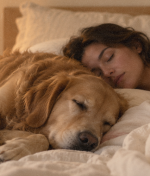
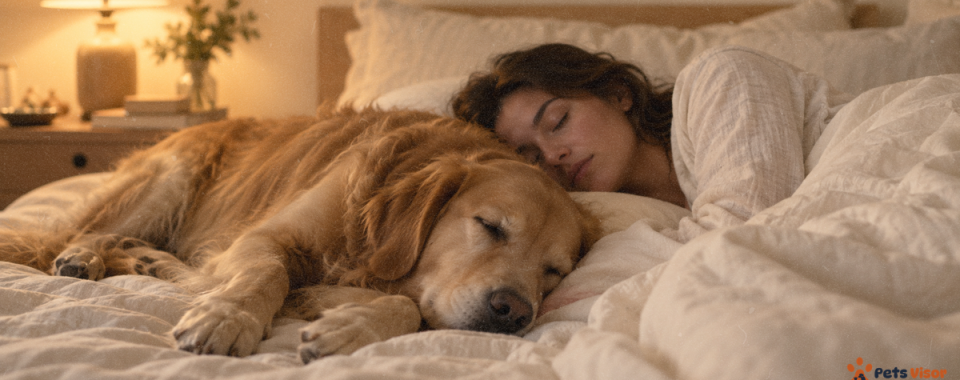
Your dog curls up beside you every single night without fail. It feels like pure love. And for most dogs, it genuinely is. But for some dogs, that same behavior is less about devotion and more about not being able to cope without you — and the two look almost identical from the outside.
So how do you actually tell the difference? When it comes to a dog sleeping beside you, the answer isn’t in where they sleep. It’s in how they sleep, how they react when they can’t, and five specific signals that most owners never think to look for.
Why Dogs Sleep Beside You: The Real Science Behind It
Dogs sleeping close to their humans isn’t a modern habit born from being spoiled. It goes back thousands of years. In the wild, sleep is the most vulnerable state any animal can be in — senses dim, defenses drop. Sleeping close to trusted packmates meant shared vigilance and shared warmth. That instinct didn’t disappear when dogs moved indoors.
When your dog chooses to sleep pressed against your leg or curled near your head, they’re not just seeking comfort. They’re also offering it. Research on canine attachment shows that dogs form bonds with their owners that are functionally similar to the secure base attachment seen between human infants and their parents. Your dog sleeping beside you, in their biology, means: this person is my safe place.
Mutual touch also triggers oxytocin — the bonding hormone — in both dogs and humans. So the physiological benefit of co-sleeping is real for both of you. Studies suggest that oxytocin levels rise during close physical contact with a trusted person or animal, reinforcing the emotional bond each time it happens.
None of that means every dog who sleeps beside you is doing so from a place of security. Some are. Some aren’t. The behavior looks the same. The emotional state underneath it doesn’t.
Choice vs. Anxiety: The One Question That Changes Everything
The single most important distinction when your dog sleeping beside you becomes a question worth asking is this: is your dog sleeping here because they want to, or because they can’t settle without it?
A dog sleeping beside you by choice can also sleep elsewhere. They prefer your company — they’d choose the bed over a dog bed in the next room — but if you closed the bedroom door tonight, they’d eventually settle on the other side, maybe a little annoyed, but calm. They might check in at the door, but they wouldn’t spiral.
A dog sleeping beside you out of anxiety is a different picture. That dog must maintain contact or proximity to regulate their own emotional state. They’re not choosing you. They’re depending on you as a coping mechanism. And that distinction matters because the second version often masks a deeper anxiety that affects their daytime behavior too — one that doesn’t resolve on its own.
In my experience, owners rarely recognize this distinction until they accidentally test it — a night away, a closed door during a partner’s illness — and the dog’s reaction tells them everything.
5 Body Language Signs Your Dog Is Anxious, Not Just Affectionate
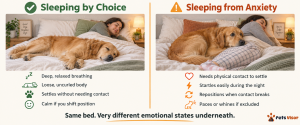
When your dog is sleeping beside you out of secure attachment, their body shows it. Relaxed muscles. Deep, slow breathing. Occasional dream-twitching. They may shift positions but settle easily. They wake calmly if you move, maybe lift their head, then go back to sleep.
Anxiety looks different. Sometimes dramatically. Sometimes subtly enough that you’ve been reading it wrong for months.
1. They Can’t Settle Unless Touching You
A securely attached dog will sleep near you. An anxious dog needs physical contact — paw on your leg, chin on your ankle, pressed against your back. The moment you shift and break contact, they reposition to reestablish it. This isn’t cuddling. It’s self-regulation through contact.
2. They Startle or Wake Frequently During the Night
A dog sleeping deeply beside you out of trust will sleep deeply. Full stop. An anxious dog stays in a lighter, more vigilant sleep state — startling at sounds that wouldn’t wake a secure dog, checking your position repeatedly, unable to cycle through proper rest. If your dog seems tired during the day despite sleeping in the bed all night, disrupted sleep is worth considering.
3. They Pace or Whine If the Bedroom Door Is Closed
This is the clearest behavioral test. A dog who prefers your company but isn’t dependent on it will show mild frustration at a closed door — maybe a check-in sniff, maybe a brief whine — and then settle. A dog with nighttime anxiety will pace, scratch, whine repeatedly, or seem genuinely unable to relax on the other side of that door for any length of time.
4. Their Daytime Clinginess Matches Their Nighttime Behavior
Separation anxiety doesn’t clock out at sunrise. If your dog follows you to every room, can’t settle when you’re home but in another space, panics at pre-departure cues like keys or shoes, or shows distress when you leave — that nighttime need to sleep beside you is almost certainly part of a larger anxiety picture, not a standalone sleep preference.
5. They Show Stress Signals Right at Bedtime
Yawning excessively when you start your nighttime routine, panting in a cool room at bedtime, pacing before settling, or needing to check every corner of the bedroom before they’ll lie down — these are stress signals, not tiredness. A dog settling calmly for sleep looks relaxed from the moment the lights go out.
Here’s a video that walks through these signs with real examples so you can see exactly what to look for:
The 3-Night Test: How to Know for Sure
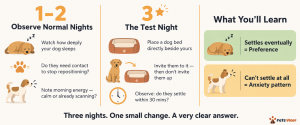
No single night tells you much. Dogs have off nights. You have off nights. But three consistent nights of observation, with one small change, can tell you a great deal about whether your dog sleeping beside you is driven by preference or anxiety.
Night 1 and 2: Let everything stay the same. Watch your dog settle. Notice whether they need contact to stop repositioning. Notice how deeply they sleep. Notice whether they startle easily or cycle through deep, relaxed rest. Note their morning energy — a well-rested dog wakes calmly and stretches. An anxious dog often wakes alert, already scanning.
Night 3: Set up a comfortable dog bed directly beside yours — same room, same proximity, but not on the bed itself. Invite your dog to it with a treat or their favorite blanket, then get into bed and don’t invite them up.
A dog sleeping beside you by preference will likely try to get on the bed, possibly whine briefly, and then — within 20 to 30 minutes — settle on the floor bed or the nearby surface. Some will take longer. Most will settle.
A dog driven by anxiety will often be unable to settle at all. Pacing, persistent whining, scratching at the bed frame, repeatedly trying to get up. If that’s what you see on night three, you’re likely looking at an anxiety pattern, not a preference.
Take Bear, a 4-year-old golden retriever I know well — his owner assumed he slept in the bed because he loved her. When she tried night three for a health reason (she’d had surgery and needed space), Bear paced for over an hour, whining at intervals, unable to settle on the dog bed six inches from the mattress. That wasn’t preference. That was a dog who had quietly developed a nighttime anxiety dependency that nobody had caught because the co-sleeping had managed it so effectively.
Understanding how your dog uses sleep positions to communicate their emotional state adds another layer to reading this — where on the bed they sleep and how they position their body both carry meaning.
Does Letting Your Dog Sleep Beside You Cause Separation Anxiety?
This is the question owners worry about most — and the answer is genuinely reassuring. Co-sleeping does not cause separation anxiety. Current research is clear on this. The location of your dog’s sleep is not the variable that determines whether they can handle being alone during the day.
What matters is the overall attachment pattern. A dog who sleeps in your bed but handles your departures calmly, settles independently during the day, and can relax when you’re in another room is showing secure attachment. The bed is just where they prefer to sleep. There’s no behavioral problem here.
Where co-sleeping can become complicated is when anxiety already exists and sleeping beside you becomes the main coping mechanism — the one tool the dog relies on to manage their emotional state at night. In that case, the co-sleeping isn’t causing the anxiety, but it is preventing the dog from ever developing any tolerance for being without you. That’s worth addressing, but the solution isn’t abruptly banishing your dog from the bedroom. It’s working on the underlying anxiety while gradually building their ability to self-settle.
After years of watching dogs do this, the dogs who handle change best — a new schedule, a partner traveling, a closed door — are the ones who have some practice settling independently, even if co-sleeping is the default. Building that skill is a kindness, not a rejection. The VCA Animal Hospitals’ guide on separation anxiety outlines exactly when to involve a professional — a useful reference if the signs you’re seeing go beyond nighttime.
What to Do If Your Dog’s Co-Sleeping Is Anxiety-Driven
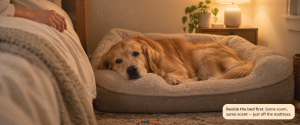
The goal isn’t to stop your dog from sleeping near you — unless you want that for your own reasons. The goal is to ensure they can sleep near you from a place of choice, not dependency.
Start by building daytime independence first. Practice short, calm separations while you’re home — different rooms, closed doors, brief absences — rewarding relaxed settling with treats and calm praise. Dogs who can self-settle during the day transfer that skill to nighttime much more easily.
At night, introduce a dog bed beside yours before attempting any greater distance. The Big Barker 7″ Pillow Top Orthopedic Dog Bed placed directly beside your bed maintains proximity without full contact — for many dogs, the scent and presence is enough to settle them without the physical dependency of being on the mattress.
If daytime anxiety is significant — destructive behavior when alone, excessive vocalization, inability to settle — that conversation belongs with your vet or a certified behaviorist before trying to change the sleep arrangement. Tools like the Adaptil Calm Home Diffuser can reduce background anxiety while behavioral work happens, making the transition to independent settling much smoother.
And if your dog tends to be restless at night more broadly, understanding why dogs stretch before and after sleep can tell you something about their physical and emotional readiness to rest — sometimes restlessness has a physical component worth ruling out.
Frequently Asked Questions
Does my dog sleeping with me cause separation anxiety?
No — current research is clear that co-sleeping does not cause separation anxiety. The variable that determines whether a dog can handle being alone is the overall attachment pattern, not where they sleep. A dog who sleeps in your bed and handles daytime separations calmly is showing secure attachment. The concern arises only if anxiety already exists and the co-sleeping becomes the sole coping mechanism.
How to tell if my dog sleeps with me out of anxiety or preference?
The clearest test is what happens when the arrangement changes. A dog sleeping beside you by preference will settle — perhaps after brief protest — when given a comfortable alternative nearby. A dog driven by anxiety will pace, whine persistently, and be unable to settle even with a comfortable bed right beside yours. Daytime behavior is also a major clue: anxiety-driven co-sleeping is almost always paired with daytime clinginess and difficulty settling when you’re in another room.
Should I let my dog sleep in my bed?
If both of you sleep well, there are no hygiene concerns, and your dog can also settle elsewhere when needed — there’s no behavioral reason not to. The arrangement becomes worth reconsidering if it’s disrupting your sleep quality, if your dog is showing signs of unhealthy dependency, or if it’s reinforcing an anxiety pattern that affects their daytime wellbeing. It’s ultimately a personal and practical decision, not a moral one.
Why does my dog sleep pressed against me specifically?
Physical contact during sleep amplifies the sense of security for many dogs — your warmth, scent, and the feel of your body reinforce the bond. Some dogs do this for comfort and closeness; others do it specifically because losing contact triggers anxiety and repositioning is their way of managing that. If your dog must maintain contact to stay settled rather than choosing it when possible, it leans toward the anxiety end of the spectrum.
How do I get my dog to sleep in their own bed without distressing them?
Start with the dog bed placed directly beside yours — same room, same proximity, just off the mattress. Build daytime independent settling first using treats and calm reinforcement for relaxed alone time in other rooms. Transition gradually rather than suddenly: beside the bed first, then room door open, then eventually wherever you’d like them. If your dog can’t settle even inches from you, that points to an anxiety level that benefits from professional behavioral support before the sleeping arrangement changes.
A dog sleeping beside you is one of the most common and most misread behaviors in dog ownership. For most dogs, it’s genuine trust and warmth — a choice that reflects how safe they feel in your world. But for some, it’s the only tool they have to manage anxiety they’d otherwise be unable to handle alone, and that deserves a different kind of attention.
The difference isn’t always obvious at first glance. But once you know the five signs and run the 3-night test, the picture usually becomes clear. And whatever you find — preference or anxiety — understanding it is the first step to responding in a way that actually helps your dog. To keep reading about the quiet signals dogs send through their physical behavior, your dog’s sleeping position reveals even more about their emotional state than you might expect.
Does your dog sleep pressed against you, nearby but not touching, or somewhere else entirely — and has this article changed how you read that choice? Drop it in the comments.