
This post contains affiliate links. As an Amazon Associate, I earn from qualifying purchases.
📌 TL;DR
- The signs your dog is saying sorry are real and readable — but the science behind them is more nuanced than most people realize.
- Dogs likely don’t experience guilt the way humans do, but they absolutely perform appeasement behaviors that function as an apology in a very practical sense.
- The five signs — lowered head, tucked tail, licking, belly exposure, and bringing you something — each carry a specific meaning worth understanding.
- How you respond to these signals matters more than whether the guilt is “real” — your reaction shapes your dog’s behavior going forward.
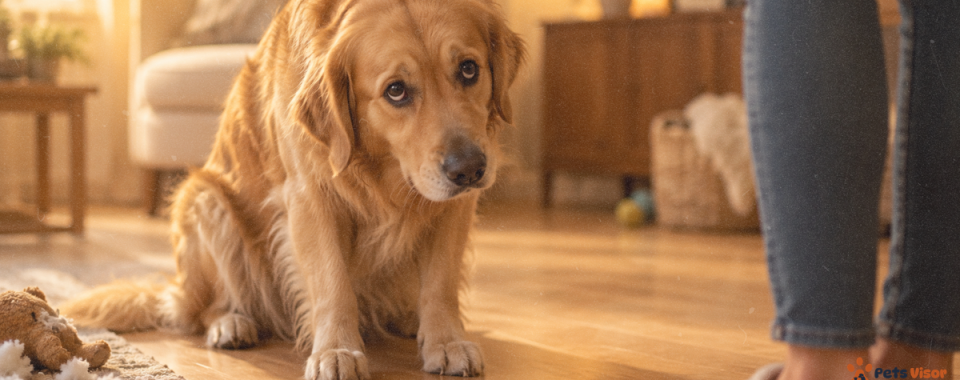
Your dog just chewed something they shouldn’t have. You walk in, survey the damage, and look at them — and suddenly they’ve transformed into the most pathetic, sorry-looking creature you’ve ever seen. Head down, tail tucked, eyes wide. Your heart immediately softens.
But are they actually sorry? The signs your dog is saying sorry are real behaviors with real meaning — but the story behind them is more interesting than a simple yes or no. Here’s what those five behaviors actually mean, what the science says, and why any of it matters for how you respond.
Do Dogs Actually Feel Sorry? What the Science Says First
Before getting into the specific signs your dog is saying sorry, this part is worth knowing — because it changes how you’ll read everything that follows.
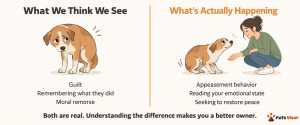
Research on canine guilt, most notably a 2009 study by dog cognition scientist Dr. Alexandra Horowitz, found something surprising: dogs displayed the classic “guilty look” in response to being scolded — regardless of whether they had actually done anything wrong. Innocent dogs, when their owners assumed they’d misbehaved and spoke to them accordingly, showed the same tucked tail, averted eyes, and lowered body as dogs who had actually chewed the sofa.
What does that mean? It means the “guilty look” is at least partly a response to your body language and emotional state — not necessarily a confession of remembered wrongdoing.
Does that make the behavior meaningless? Not at all. What dogs are doing is performing what behaviorists call appeasement — a set of social signals designed to de-escalate tension, communicate non-threat, and restore harmony with someone they care about. In practical terms, appeasement is what sorry looks like in dog language. It may not carry the same moral weight as a human apology, but it serves the same social function. And that’s worth something.
Sign #1: They Lower Their Head and Won’t Meet Your Eyes
This is the most universally recognized of the signs your dog is saying sorry, and the one that’s hardest to stay angry at. A dog who lowers their head after sensing your displeasure is performing a classic appeasement gesture — physically making themselves smaller to signal: I am not a threat. I am not challenging you. Please don’t be angry.
In dog body language, lowering the head is specifically a conflict-avoidance signal. Combined with averted eyes — looking slightly away rather than holding your gaze — it’s your dog’s way of saying “I’ve noticed you’re unhappy, I’m not going to escalate this, and I want us to be okay.”
The averted eyes piece is particularly interesting. Direct prolonged eye contact in dog communication signals challenge or dominance. By looking away, your dog is actively choosing the opposite: deference, softness, peace-seeking. It’s one of the more deliberate gestures in the canine vocabulary.
In my experience, this sign is most genuine — in the sense of being most behaviorally connected to your emotional state — when it happens in real time as you react. Your dog is reading your face and body and responding immediately. That’s not nothing.
Sign #2: The Tucked Tail and Lowered Body
A tail tucked between the legs paired with a lowered body posture is one of the clearest submission signals dogs have. It’s ancient, instinctive, and universally understood across canine communication — including with humans, because dogs have learned to read us with remarkable accuracy over thousands of years of co-evolution.
When your dog tucks their tail and crouches slightly, they’re physically reducing their profile. In the dog world, this signals: I am smaller than you right now. I am not competing. I am deferring. It’s the body language equivalent of raising a white flag.
Take Bear, a 3-year-old golden retriever I know well — every time he knocked something off a table or got into the trash, he’d greet his owner at the door with this exact posture before she’d even seen the mess. He wasn’t remembering what he’d done. He was reading the shift in her energy the moment she walked in — the slightly more tense posture, the pause before she spoke — and responding to that signal. The apology was real. The guilt was debatable.
Understanding how your dog’s whole-body posture reveals their emotional state makes this sign much easier to read in context — a tucked tail during play means something very different than one that appears when you walk in after a long day.
Sign #3: They Lick Your Hand or Face
Licking has multiple meanings in dog communication, and in the context of sensing your displeasure, it’s almost always appeasement. Dogs use licking to soothe tension — both their own and yours. It’s a behavior that goes back to early puppyhood, when licking the mother’s face was a submissive greeting and bonding signal.
When your dog licks your hand after you’ve been upset with them, they’re not trying to distract you or butter you up in a calculated way. They’re reaching for a behavior that, in their experience, tends to soften tense situations. Licking releases endorphins in dogs — it’s self-soothing as much as it is an offering to you. And it often works, because it’s genuinely hard to stay angry at a dog who’s covering your hand in gentle, persistent kisses.
I’ve seen this with so many dogs: the licking that follows a scolding is softer, slower, and more persistent than their usual greeting licks. It reads differently because it is different — more careful, more deliberate, more peace-seeking.
Want to see each of these signs in action with real dogs? This video walks through all five:
Sign #4: They Expose Their Belly or Roll Onto Their Back
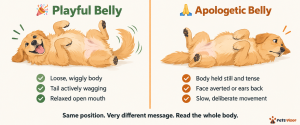
Rolling onto their back and exposing the belly is the most extreme submission signal in a dog’s body language repertoire. It’s a full vulnerability display — showing the softest, most unprotected part of their body. In nature, this would signal total deference to a more dominant individual.
When your dog does this after a scolding or after sensing your frustration, they’re communicating maximum appeasement: I am not a threat. I am completely deferring to you. Please let this be over.
Not all belly exposure is apologetic, of course. A dog who flops over for a belly rub mid-play is inviting interaction, not apologizing. Context matters enormously. The apologetic belly exposure tends to come with a tense body, slow movement, and a face that’s turned away — different from the loose, wiggly body of a dog who just wants scratches.
After years of watching dogs do this, the distinction becomes obvious once you know to look for it. Same position. Completely different energy underneath.
Sign #5: They Bring You Something — Anything
This one surprises people the most. Your dog just chewed your shoe. Now they’re trotting over with their favorite toy — or another shoe, or a sock, or whatever they grabbed on the way — and dropping it at your feet. What on earth?
This is a peace offering. Dogs who bring objects to someone they’ve upset aren’t being tone-deaf. They’re reaching for a behavior that has, in their experience, produced positive reactions before. Bringing you something = you light up = the tension breaks. It’s social problem-solving, and it’s actually quite sophisticated when you consider it from their perspective.
Some dogs do this with their owners after any kind of emotional tension — not just after misbehaving. It’s their way of resetting the interaction, offering something to bridge the gap. The fact that they’re offering their own prized possession, specifically to you, is also an extension of trust. They share their things with the people who matter to them.
This connects directly to the broader picture of how dogs communicate care and bonding — much like how physical behaviors such as stretching toward you carry their own layer of meaning that most owners read past.
How Should You Actually Respond to These Signs?

Here’s where it gets practically important. Your response to the signs your dog is saying sorry shapes the behavioral pattern going forward.
The worst response is prolonged anger or continued scolding after your dog has already offered appeasement. Dogs live in the present — they can’t connect a lecture to something that happened five minutes ago. Once they’ve offered the appeasement signals, that cycle is functionally complete from their perspective. Continuing to push means you’re now creating anxiety about your unpredictability, not teaching a lesson about the original behavior.
The most effective response is a calm, brief acknowledgment and then a return to neutral. No need to be effusively warm immediately — a quiet pat and a return to your normal energy is enough. What your dog needs to know is that the tension has passed and they’re safe.
What you do want to address is the original behavior — not in the moment of apology, but through consistent training going forward. If your dog keeps chewing things they shouldn’t, the solution is management (keeping those things away) and enrichment (giving them enough appropriate outlets for their energy and need to chew). Products like the Benebone Real Flavor Wishbone Chew Toy or KONG Classic Stuffable Dog Toy give heavy chewers a deeply satisfying alternative that makes the off-limits items less interesting by comparison.
And if your dog is showing appeasement behaviors frequently — not just after specific incidents but regularly around you or certain family members — that’s worth paying attention to as a sign of chronic anxiety rather than occasional mischief. The American Kennel Club’s guide on dog stress signals is a useful reference for knowing when appeasement crosses into something that needs behavioral support.
Frequently Asked Questions
Do dogs actually feel guilt when they do something wrong?
The science suggests dogs don’t experience guilt in the complex, self-reflective way humans do. Research shows that the “guilty look” appears in response to owner behavior — scolding and displeasure — rather than as a sign that the dog remembers and regrets a specific action. What dogs are doing is appeasement: reading your emotional state and responding with submissive signals to de-escalate tension. It’s not guilt in the human sense, but it’s not nothing either — it’s sophisticated social intelligence.
What does it mean when a dog lowers their head after misbehaving?
Lowering the head is one of the clearest conflict-avoidance signals in dog body language. It physically reduces their profile and signals non-threat and deference. When paired with averted eyes, it means your dog has picked up on your displeasure and is actively choosing the opposite of confrontation — softness, peace-seeking, a desire to restore the relationship. In practical terms, it functions as an apology even if the internal emotional experience differs from human guilt.
How do I know if my dog is apologizing or just scared?
The body language overlaps, which is why this question matters. An apologetic appeasement display tends to include soft movement toward you — they’re engaging, seeking reconnection. A fear response more often involves moving away, hiding, freezing, or trembling. A dog who approaches you with a low head and wagging tail tip is seeking reconciliation. A dog who retreats to a corner and won’t make any contact is showing fear, not apology. If you see the latter regularly, the relationship dynamic is worth examining.
Should I comfort my dog when they show these apologetic behaviors?
A calm, brief acknowledgment is ideal — not effusive praise, which can reinforce the behavior as a tool for getting attention, and not continued scolding, which creates anxiety without teaching anything useful. Once your dog has offered appeasement, the social transaction is complete from their perspective. Returning to neutral energy with a quiet pat communicates that the tension has passed and they’re safe, which is what they need to hear.
Why does my dog bring me a toy after I’ve been upset with them?
Bringing an object is a peace-offering behavior — your dog is reaching for something that has produced positive reactions in the past and offering it as a way to reset the interaction. It’s social problem-solving: they sense tension and look for a tool to break it. The fact that they share a prized possession with you specifically also signals that you’re in their inner circle of trust. It’s one of the most practically intelligent of the apology behaviors dogs show.
The signs your dog is saying sorry are real, readable, and worth understanding — even if the science behind canine guilt is more nuanced than the adorable guilty face suggests. Whether it’s full moral remorse or sophisticated social appeasement, your dog is actively trying to restore something they value: the peace between you. That’s not a small thing.
How you respond shapes the pattern going forward — a calm return to normal tells your dog exactly what they need to know. And if you want to keep building your ability to read your dog’s quieter emotional signals, your dog’s sleeping position is another revealing window into how they really feel about their world.
Which of these five signs does your dog show most often — and does it work on you every time? Drop it in the comments.