
This post contains affiliate links. As an Amazon Associate, I earn from qualifying purchases.
📌 TL;DR
- Dogs feel rejection, frustration and fear — but not guilt or shame, which is why punishing after the fact backfires
- The most common ways owners hurt a dog’s feelings are accidental — hugging, rushing walks, ignoring signals, inconsistent rules
- Hurt feelings show up in body language first: ears back, avoiding eye contact, turning away, going quiet
- You can repair it. The fix takes about a week of small, consistent actions — not one big apology
You love your dog. You feed them, walk them, let them sleep on the good side of the bed. And you’re probably still doing two or three things that quietly hurt their feelings.
Not because you’re careless. Because nobody hands you a translation guide.
Dogs experience real emotions — fear, frustration, joy, anxiety, and something that functions a lot like rejection. The things that hurt your dog’s feelings are almost always small, ordinary moments that felt like love from your side of the leash.
Can You Actually Hurt Your Dog’s Feelings?
Yes — but not in the way most people imagine.
Dogs have the emotional range of roughly a two-and-a-half-year-old child. That means they genuinely feel fear, anger, joy, disgust, and sadness. They also feel excitement, anxiety, contentment, and something close to love.
What they don’t feel is guilt, shame, or spite. Those emotions develop later in human children and dogs never get there.
This one fact changes everything about how you should respond to them. That “guilty look” after they chewed the couch? Not guilt. That’s a dog reading anger on your face and trying to defuse it. And that’s exactly why some of the things we do with the best intentions land so badly.
7 Things That Hurt Your Dog’s Feelings
1. Pushing Them Away When They Come to You
Your dog climbs into your lap while you’re on a call. You push them down without looking. Small moment. Happens fifty times a week.
From their side, that’s a rejected bid for connection. Dogs don’t have many ways to reach you — a paw, a nudge, a lean, a stare. Every one of those is deliberate.
Here’s what makes it worse than it sounds: a dog who gets rejected enough times doesn’t get offended and try harder. They stop trying. Some get louder — more barking, more restlessness. Others just go quiet and easy, and owners think their dog got better behaved. They didn’t. They stopped believing you were listening.
You don’t have to say yes every time. Just look down, say their name, touch them for two seconds. That’s enough to keep the channel open.
2. Hugging Them
This one surprises people, and I’ve seen it go wrong in a hundred living rooms.
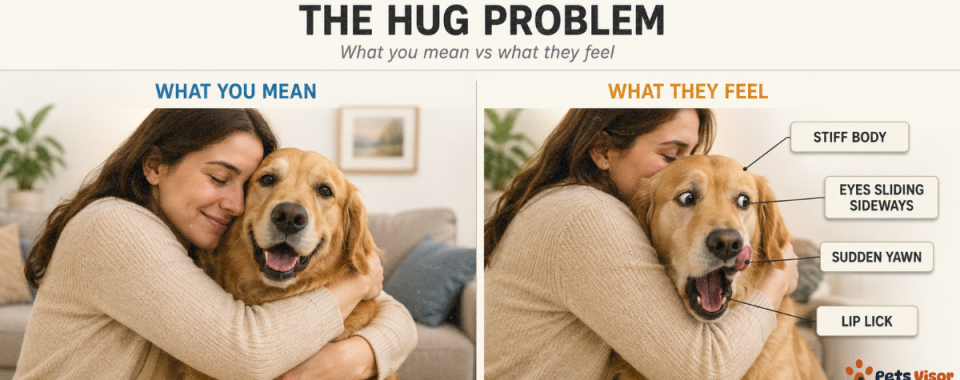
Humans hug to show love. Dogs don’t hug. In dog language, wrapping your arms fully around another animal restricts their movement — and restricted movement reads as threat, not affection.
Most dogs tolerate it because they trust you. Tolerating isn’t enjoying.
Watch what their body does next time. Stiffening. Eyes sliding sideways so you see the whites. A sudden yawn when they’re not tired. A quick lip lick. Those are all polite requests for space.
The dog version of a hug is leaning. Let them press their weight into your leg on their own terms. That’s the same message, in a language they actually speak.
3. Rushing Them Through Walks
You’ve got fifteen minutes. Your dog wants to spend eight of them at one fence post.
That fence post is the entire point of the walk. Sniffing is how dogs process the world — who came through, when, what they ate, whether they’re stressed. A walk where they can’t sniff is like being dragged through a museum blindfolded.
Constant leash-pulling to hurry them along also makes the walk itself feel like pressure. If you’re using a collar, every yank lands directly on their throat.
A front-clip harness fixes most of that — pressure goes across the chest instead of the neck. The PetSafe Easy Walk Harness is the one you’ll see recommended most often; it was designed by a veterinary behaviorist and it’s what a lot of trainers hand new clients. The 2 Hounds Design Freedom No-Pull Harness is the sturdier option if your dog is a serious puller.
Even simpler: pick one walk a week and let it be entirely theirs. They set the pace. You just hold the leash.
4. Laughing at Their Fear
Thunderstorm. Your dog is shaking under the table. You take a video because honestly, it’s a little funny.
What’s happening under that table isn’t funny to them. It’s a real stress response — elevated heart rate, stress hormones, the whole system firing.
And the one creature they’d normally look to for safety is smiling at it.
They don’t understand the joke. What they take away is that you saw them frightened and did nothing. Do it enough times and you’ve quietly taught them you’re not the one to go to when things get scary.
Low voice. Calm body. Let them come to you rather than dragging them out. Comfort doesn’t reinforce fear — that myth got debunked a long time ago.
5. Changing the Rules
Monday the couch is fine. Tuesday you’re tired and they get yelled off it. Wednesday they’re back up because they looked cute.
Dogs build their whole understanding of the world from patterns. This action produces that result. Every time.
When the result keeps changing, they can’t build the pattern. And an animal that can’t predict what’s coming stays braced — even on the good days, even when nothing’s wrong.
Pick the rule. Any rule. Then hold it. That’s not being strict. To a dog, consistency is one of the closest things to safety there is.
6. Scolding Them Hours Later
You come home to a mess. You point at it. You use the voice.
A dog connects an action to a consequence within about two seconds. Two hours later there is no connection available for them to make.
So what actually registers is: my person came home and became frightening for no reason I can find.
That lowered head and those flattened ears aren’t an admission. That’s appeasement — a dog trying to calm down someone whose mood just turned.
Catch it in the moment and a firm word works. Miss the moment and the only useful move is cleaning it up and letting it go. The failure was in the timing, never in the dog.
7. Missing the Quiet Signals
This is the one almost everybody misses, and it’s the one that costs the most.
Dogs are built to hide discomfort. In the wild, an animal that looks weak gets targeted, so the instinct to mask pain runs deep. It never got the memo that your living room is safe.
So a dog in pain doesn’t cry. They just do a little less. Slower getting up. Skipping the jump onto the couch. Longer naps. And it looks exactly like a dog who’s getting older.
Take BEAR, an old Labrador mix I knew. For months his owner watched him slow down and figured it was age. He never limped obviously. Never whined. It took a vet visit she almost postponed to find arthritis bad enough that every one of those “lazy” mornings had actually hurt.
She still says the same thing about it. He never told her. She just wasn’t looking hard enough.
She wasn’t careless. She just didn’t know what she was looking at — and honestly, most people don’t, because a dog in quiet pain looks identical to a dog who’s simply tired.
How Do You Know If Your Dog’s Feelings Are Hurt?

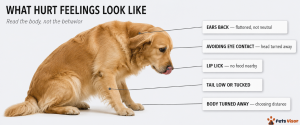
Most things that hurt your dog’s feelings show up in the body before they show up in behavior. It shows up in the body before it shows up in behavior. Here’s what to watch for:
- Avoiding eye contact — turning their head away when you speak to them
- Ears back or flattened — held low against the head rather than neutral
- Tail tucked or held unusually low
- Withdrawing — leaving the room, lying in a corner, choosing distance
- Lip licking or yawning when there’s no food and they’re not tired
- Sudden clinginess — some dogs go the opposite direction and won’t leave your side
- Loss of interest in things they normally love, including food and toys
One of these on its own means very little. Dogs yawn. Dogs nap in corners. What matters is a cluster of them showing up together, especially right after something happened between you.
One important caveat: several of these overlap exactly with signs of illness. If your dog withdraws and stops eating and you can’t point to anything that happened, that’s a vet call, not an emotional issue.
If you want to go deeper on reading canine stress signals, Preventive Vet’s body language guide is a solid reference.
How Do I Apologize to My Dog?

You can’t. Not in the way you’re imagining — dogs don’t process apologies, and a long guilty speech in a soft voice mostly just confuses them.
What you can do is repair the relationship through behavior. That works, and it works reliably.
The First Hour
Drop your energy. Sit down on the floor, at their level, and don’t reach for them. Face slightly away rather than straight on. Let them decide when to come over.
When they do, keep it low-key. A calm scratch on the chest. No big emotional reunion — that intensity is for you, not them.
The Next Few Days
This is where the actual repair happens, and it’s boring on purpose.
Hand-feed one small meal a day. Sit on the floor, offer it straight from your palm, don’t stare at them while they take it. You’re proving something their nervous system understands better than any word: your hands bring things, they don’t take things.
When they bring you something — a toy, or just their presence — don’t grab. Drop something good near them and step back.
A snuffle mat helps here too, and it’s one of the most useful cheap things you can own. The Wooltopia Snuffle Mat and the PAW5 Wooly Snuffle Mat are both solid options. Scatter food in it and let them work. It gives them a win that has nothing to do with obeying you.
Weeks, not days. It’s slow because trust is slow. But it’s the actual fix, not just a suggestion to be nicer.
Do Dogs Remember When You Yell at Them?

Not the way you remember it.
Dogs don’t replay the incident. What they retain is an association — this person, this room, this tone of voice, that feeling. Those associations build up over time and shape how safe they feel around you generally.
One bad afternoon isn’t going to undo years of good ones. A pattern will.
Which is honestly the good news buried in all of this. Their memory works on repetition, not on single events. So the small, consistent, boring things you do right count for far more than any one moment you got wrong.
Their body tells you where you stand — what your dog’s stretch is actually telling you covers another signal most owners walk right past.
Frequently Asked Questions
Can you actually hurt a dog’s feelings?
Yes. Dogs experience fear, frustration, anxiety, sadness and something that works like social rejection. What they don’t experience is guilt, shame or spite — those develop later in human children and dogs don’t reach that stage. So a dog can absolutely feel hurt by being ignored or frightened, but they can’t feel guilty about the couch they chewed.
How do I know if my dog’s feelings are hurt?
Look at their body language rather than their behavior. Ears held back, avoiding eye contact, turning their head away, tail tucked low, withdrawing to another room, or losing interest in food and toys. A single sign means little — it’s several appearing together, right after something happened, that tells you something landed badly.
Do dogs remember when you yell at them?
Not as a specific memory. Dogs form associations rather than recollections — they connect your tone, your body language and the setting with how it made them feel. One incident rarely does lasting damage. A repeated pattern does, because that’s what builds the association.
How do I apologize to my dog?
Skip the verbal apology — it doesn’t translate. Repair happens through behavior instead. Sit at their level without reaching for them and let them approach on their own. Then over the following week, hand-feed one small meal a day and give them low-pressure wins like a snuffle mat. Consistency does the work, not one big gesture.
Why does my dog seem fine when I do these things?
Some dogs stop reacting because reacting never changed anything. That looks like a calm, easygoing dog, but it can be resignation rather than contentment — this is more common in rescues and dogs from difficult backgrounds. If your dog seems unusually unbothered by everything, gentle relationship-building work is worth doing regardless.
What This Actually Comes Down To
Almost nobody hurts their dog’s feelings on purpose. The things that hurt your dog’s feelings are ordinary moments — a hug, a rushed walk, a hand that pushed them away without looking.
Love was never the missing piece. What most of us never got handed is a way of reading what our dog needs underneath all that love.
Not more love. Better eyes.
Your dog is probably testing one of these on you tonight, whether they’re asleep at your feet or watching you from across the room. They’re not keeping score. They’re just hoping tonight’s the night you notice.
I went further into this in a video — including the one mistake that sits underneath all the others:
Which one of these hit you hardest? Drop your dog’s name in the comments and tell me — I read every one.