
This post contains affiliate links. As an Amazon Associate, I earn from qualifying purchases.
📌 TL;DR
- Products that calm anxious dogs work best when matched to the specific type of anxiety your dog has — event-based, separation, or chronic background stress.
- The ThunderShirt and Adaptil diffuser are the two most consistently effective non-prescription options and a strong starting point for most dogs.
- Lick mats and snuffle mats are underrated — they trigger a neurological calming response that works faster than most supplements.
- No product replaces behavioral support for severe anxiety, but the right tool can make a meaningful difference for mild to moderate cases.
Your dog is panting, pacing, or plastered to your legs — and you want to help them right now. Not in six weeks after a behavioral program finishes. Now. The good news is that several products actually work. The less obvious news is that which one works depends entirely on what’s driving the anxiety.
Here are 7 products that calm anxious dogs, organized by the anxiety type they target best — so you’re not guessing, and you’re not buying the wrong thing.
First: Match the Product to the Anxiety Type
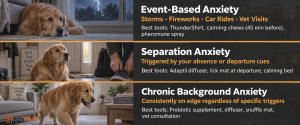
Before spending money on calming products for dogs, a two-minute assessment saves a lot of trial and error. Dog anxiety generally falls into three categories — and the product that helps one type can do very little for another.
- Event-based anxiety — triggered by specific predictable events: thunderstorms, fireworks, vet visits, car rides, grooming. Your dog is fine until that thing happens. Best tools: pressure vests, short-acting calming chews, pheromone spray.
- Separation anxiety — triggered specifically by your absence or departure cues. Your dog shows distress when you leave, not just during loud events. Best tools: pheromone diffuser, enrichment tools like lick mats and Kongs, long-acting supplements, calming beds.
- Chronic background anxiety — a dog who seems consistently on edge, reactive, or unable to fully relax regardless of specific triggers. Best tools: long-acting supplements, probiotics, environmental management (beds, diffusers), vet consultation.
Most dogs show some overlap. But identifying the primary driver tells you where to start.
Product #1: ThunderShirt Classic Dog Anxiety Jacket – Best for Event-Based Anxiety
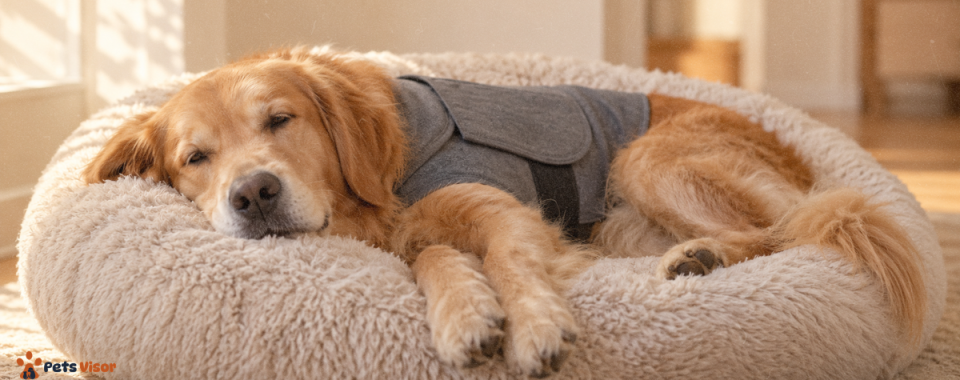
The ThunderShirt is the most consistently recommended non-prescription anxiety product on the market — and for good reason. It works on the same principle as weighted blankets for humans or swaddling for infants: gentle, sustained pressure applied to the torso activates the nervous system’s calming response.
Surveys of over 2,000 dog owners reported that roughly 80% saw improvement in anxiety symptoms. That number won’t mean much if your dog is in the 20%, but it’s a higher success rate than most over-the-counter options. It works best for event-based anxiety — storms, fireworks, car trips, vet visits — and should be put on before the trigger starts, not once the dog is already spiraling.
A few things worth knowing: some dogs need two or three exposures before they respond. Others respond immediately. And a small number of dogs dislike wearing anything fitted — if yours freezes when anything snug touches them, this isn’t the right tool regardless of how effective it is for other dogs.
The ThunderShirt Classic Dog Anxiety Jacket comes in sizes XXS through XXL, is machine washable, and is the version most consistently stocked on Amazon with recent reviews.
Product #2: Adaptil Calm Home Diffuser – Best for Separation Anxiety and Chronic Stress
Adaptil works on a completely different mechanism than pressure. It releases a synthetic version of the dog-appeasing pheromone — the natural chemical nursing mother dogs produce to calm their puppies. This pheromone communicates “you are safe, you are with your family” at a biological level that doesn’t require your dog to learn anything or tolerate wearing anything.
In my experience, the Adaptil diffuser is best suited for dogs with separation anxiety or chronic background stress — the kind of anxiety that’s present across many situations rather than spiking during specific events. It works slowly (some dogs show improvement within days, others take a few weeks of consistent use) and works best as a foundation alongside other tools rather than a standalone fix.
One realistic note: some dogs respond strongly to pheromone therapy and others don’t respond at all. There’s no reliable way to predict which category your dog falls into without trying it. But it’s non-sedating, has no known medication interactions, and is genuinely worth trying before moving to prescription options.
The Adaptil Calm Home Diffuser Starter Kit covers approximately 700 square feet and runs continuously. Place it in the room your dog spends most time in, particularly during alone time.
Understanding how your dog’s sleeping environment affects their anxiety connects directly here — your dog’s sleeping position reveals how settled they actually feel, and a dog who can’t relax in sleep is often showing chronic background stress worth addressing.
Product #3: LickiMat Classic Buddy – Best Immediate Calming for Any Anxiety Type
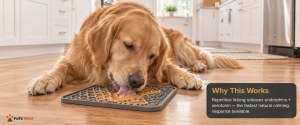
This is the most underrated tool on this list. A lick mat isn’t just a distraction — it triggers a genuine neurological calming response. Repetitive licking releases endorphins and promotes the production of serotonin. It reduces heart rate and shifts the nervous system toward a calmer state faster than most supplements can act.
Take Bear, a 4-year-old golden retriever I know well — he’d go into full shutdown during thunderstorms: panting, pacing, unable to settle. His owner started smearing the lick mat with peanut butter and freezing it the night before forecast storms. Within two weeks, Bear had a new storm association: “storm coming = amazing frozen peanut butter mat.” He still noticed the storm. He just stopped spiraling.
That’s the real power of the lick mat — it creates a positive counter-association with the trigger while delivering immediate physiological calming. It’s also one of the few tools that works effectively for all three anxiety types: event-based (introduce during the trigger), separation anxiety (give it as you leave), and chronic stress (use it during naturally high-stress periods in the day).
The LickiMat Classic Buddy Dog Treat Mat is dishwasher safe, has multiple texture zones that extend licking time, and works with peanut butter, plain yogurt, pumpkin puree, or wet food. Freeze it to make it last longer.
Product #4: Snuffle Mat – Best for Boredom & Driven and Chronic Anxiety
Sniffing is the single most mentally tiring activity a dog can do. A 15-minute snuffle mat session is neurologically equivalent to a much longer physical walk in terms of the mental energy it expends. For dogs whose anxiety is partly driven by under-stimulation — and many are — a snuffle mat addresses a root cause, not just a symptom.
I’ve seen this with so many dogs: owners who added a daily snuffle mat session reported their dogs were noticeably calmer in the hours afterward. Not sedated. Just settled — the way a dog looks after they’ve had a genuinely satisfying physical and mental experience.
Snuffle mats work particularly well for dogs with chronic background anxiety and dogs who become destructive or restless when left alone. They give the brain somewhere productive to go. The PAW5 Wooly Snuffle Mat for Dogs is a consistently well-reviewed option with dense fibers that hide treats effectively and is machine washable — which matters more than it sounds.
Product #5: Zesty Paws Calming Bites – Best Calming Chew for Situational Use
Calming chews are the category with the most variation in quality — and the most variable results. The ones worth using contain ingredients with actual research behind them: L-theanine (promotes relaxation without sedation), melatonin (for sleep-adjacent calming), ashwagandha (adaptogen that blunts the stress hormone response), and chamomile.
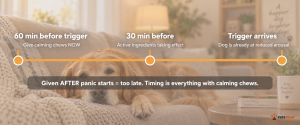
What calming chews are not: fast-acting. Most need 30–60 minutes to take effect, which means giving them after your dog is already panicking is largely useless. Give them 45 minutes before a predictable trigger — before the storm is forecast to hit, before the fireworks start, before the car trip begins.
After years of watching dogs do this, the owners who see the best results from calming chews are the ones who use them proactively and consistently — not as a last-resort grab when the dog is already at a 9 out of 10 on the anxiety scale.
The Zesty Paws Calming Bites for Dogs contain Suntheanine (a clinically studied form of L-theanine), ashwagandha, and melatonin, and are one of the most consistently reviewed options currently available. Check the most recent Amazon listing for the current formula and reviews before purchasing — this category updates frequently.
Product #6: Purina Pro Plan Calming Care Probiotic – Best for Chronic and Long-Term Anxiety
This one is the most science-backed on the list, and also the least immediately satisfying — because it takes time. Purina Pro Plan Calming Care contains a specific strain of probiotic (Bifidobacterium longum BL999) that has been studied in dogs and shown to reduce anxious behaviors over time by improving the gut-brain connection.
Research on the gut-brain axis in dogs is still emerging, but the mechanism is real: the gut produces a significant portion of the body’s serotonin, and improving gut microbiome health has measurable effects on mood and stress response. This isn’t a product that calms your dog during a thunderstorm. It’s a product that makes your dog a less anxious animal over 6–8 weeks of consistent daily use.
For dogs with chronic background anxiety, this is one of the most worthwhile long-term investments on this list. It comes in individual daily packets mixed into food, has no known interactions, and works well layered with other tools on this list. The Purina Pro Plan Veterinary Supplements Calming Care is available in 30-day and 45-day supplies.
Product #7: Calming Donut Dog Bed – Best for Sleep Anxiety and General Comfort
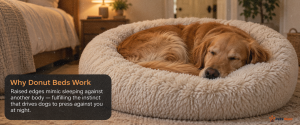
Dogs feel most vulnerable during sleep — it’s the state where they’re least able to respond to threats. A dog whose anxiety manifests as inability to settle, disrupted sleep, or restlessness at night often responds significantly to a bed that mimics the physical sensation of being curled against another body.
Donut-style beds with raised edges give dogs something to press against — fulfilling the same instinct that drives them to sleep pressed against you or a wall. The filling around the edges provides gentle proprioceptive feedback (physical pressure awareness) that activates the calming nervous system response, similar in principle to the ThunderShirt but during rest rather than active anxiety episodes.
The Best Friends by Sheri Original Calming Shag Fur Donut Cuddler is the most consistently reviewed option in this category on Amazon, with a machine-washable cover and a design that works for dogs from small to large. It’s particularly effective when placed in a consistent location your dog associates with safety.
For dogs whose sleep anxiety is connected to separation from you, placing the bed near (but not on) yours and pairing it with the Adaptil diffuser in the same room addresses both the sensory and pheromone channels simultaneously. And if you want to understand more about how physical positioning during sleep reflects your dog’s anxiety level, your dog’s sleeping position tells you more about their emotional state than most owners realize.
What If None of These Work?
If you’ve tried two or three of the above consistently and seen no meaningful improvement, that’s important information — not failure. Severe anxiety in dogs often has a physiological component that over-the-counter products can’t address alone. Prescription options like trazodone, fluoxetine, or gabapentin used alongside behavioral modification are genuinely effective for dogs with significant anxiety, and they don’t have to be permanent.
The American Kennel Club’s guide on dog anxiety outlines clearly when to move from product-based management to veterinary and behavioral intervention — worth reading if you’re unsure where your dog falls.
Frequently Asked Questions
What actually works for dog anxiety?
The products with the strongest track records are the ThunderShirt (for event-based anxiety), Adaptil pheromone diffuser (for separation and chronic stress), and lick mats (for immediate calming across anxiety types). Calming chews with L-theanine and ashwagandha are effective when used proactively — given 45 minutes before a known trigger, not after anxiety has already peaked. For chronic anxiety, Purina Pro Plan Calming Care probiotic has the most research backing of any supplement currently available without a prescription.
Do calming chews actually work for anxious dogs?
For mild to moderate anxiety, yes — particularly chews containing clinically studied ingredients like Suntheanine (L-theanine), ashwagandha, and melatonin. The critical variable is timing: chews need 30–60 minutes to take effect, so they must be given before the anxiety trigger begins, not during or after. Dogs with severe anxiety typically need more than chews alone. Think of calming chews as a tool that takes the edge off, not a complete solution for significant anxiety disorders.
What is the best product for dog separation anxiety specifically?
For separation anxiety specifically, the most effective combination is the Adaptil Calm Home Diffuser running continuously in your dog’s main living space, paired with a frozen lick mat or stuffed KONG given as you leave — so your departure becomes a positive trigger rather than a distressing one. A calming donut bed in a consistent safe spot adds a comfort anchor. For significant separation anxiety, these tools work best alongside a behavioral protocol; products alone rarely resolve true separation anxiety at its root.
Is the ThunderShirt actually effective or just marketing?
The pressure-therapy mechanism behind the ThunderShirt is real — gentle sustained pressure activates the parasympathetic nervous system and promotes calming across multiple species. Owner surveys suggest around 80% of dogs show some improvement. That said, it doesn’t work for every dog (some dislike wearing fitted clothing entirely) and works best when introduced before anxiety peaks rather than during a full panic response. It’s not marketing — but it’s also not a guaranteed fix for every dog in every situation.
Can I use multiple calming products at the same time?
Yes — and layering is often more effective than relying on a single product. The ThunderShirt and a calming chew together during a storm, for example, address two different mechanisms simultaneously (pressure and neurochemical). The Adaptil diffuser running continuously plus a lick mat during departures is a common and effective combination for separation anxiety. The exception is combining multiple supplements with overlapping ingredients — check with your vet before stacking calming chews with other melatonin or L-theanine products to avoid inadvertently overdosing on any single ingredient.
The right products that calm anxious dogs aren’t the most expensive or the most heavily marketed — they’re the ones matched correctly to what’s actually driving your dog’s anxiety. Start with identifying the anxiety type, pick one or two tools that fit it, introduce them before the trigger where possible, and give them enough time to work before writing them off.
Most dogs with mild to moderate anxiety see meaningful improvement with the right combination of environmental management and one or two of the products on this list. And if you want to keep building your ability to read your dog’s stress signals before they escalate, understanding why dogs stretch is another window into how they manage physical and emotional tension that most owners completely overlook.
Which of these has your dog tried — and did it actually help? Drop your experience in the comments. Real-world results from real owners are genuinely useful here.